





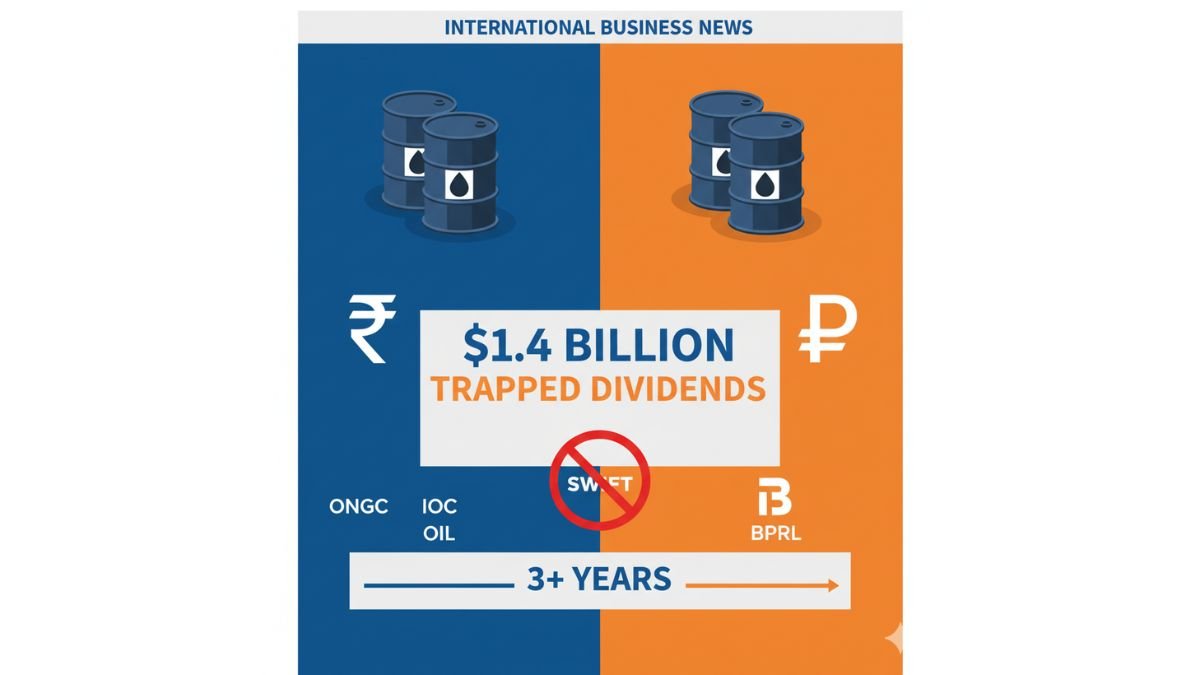
The Indian government-owned oil companies are struggling with a financial crisis never experienced before, which has seen dividend income of 1.4 billion stuck in the Russian bank accounts for over three years. The nature of this crisis is the Western sanctions that have been imposed in the wake of the invasion of Ukraine by Russia in February 2022, which have posed complicated repatriation challenges to leading Indian energy companies.
The stagnant funds indicate the dividends of the huge Indian investments in the Russian oil and gas projects, and amount to over 6 billion of the cumulative investments. These are some of the strategic purchases that make an essential part of the energy security system in India, as the country depends on oil supply to a large extent to satisfy its national energy needs.
Major Indian Companies Affected by the Crisis
ONGC Videsh (OVL), which is the foreign investment unit of Oil and Natural Gas Corporation, has had considerable investments in the Russian energy projects. The company has a 20-per-cent interest in the Sakhalin-1 project as well as 26 per cent interest in the Vankor project, and the company has about 400 million dollars in the stranded dividend income.
An even greater challenge is faced by a consortium of Indian oil corporations (IOC), Oil India (OIL) and Bharat Petroresources (BPRL). This block of shareholders jointly owns a 23.9 per cent stake in Vankor, a 29.9 per cent stake in the Taas-Yuryakh project, and a substantial amount of trapped dividends of about $1 billion, estimated by the industry.
Dividend payments keep coming in on a regular basis using Russian assets, but accessibility is not possible as a result of banking restrictions imposed by sanctions. All payments of Indian oil dividends to Russia have been deposited in Commercial Indo Bank, Moscow, an affiliate of the State Bank of India, and deposits have been made in rubles.

Banking and Payment System Restrictions
The main barrier is the fact that Russia is not a member of the SWIFT international financial messaging system. After the invasion of Ukraine, several large banks of Russia were deprived of SWIFT access, which dramatically restricted the contact of Russia with the global payment systems. This is a technological obstacle that renders the transfer of funds virtually impossible.
Russia also introduced limits to dollar repatriation in a bid to stabilise the foreign exchange markets, and this made the issue of repatriation even more complicated. These domestic policies of Russia reinforce the regime of the international sanctions, and provide numerous regulatory obstacles.
Jurisdictional Complications Add Complexity
The international jurisdiction problem also makes matters more complex in terms of solutions. Most of the Indian investments in Russian energy assets make use of special purpose vehicles (SPVs) that are incorporated in offshore business locations such as Singapore. The structure implies that any transaction that involves these funds should be in compliance with the laws of not only Indian and Russian jurisdictions.
As one industry analyst observed, “The existence of overseas SPVs puts a web of regulatory demands so that simple bilateral solutions are virtually impossible using the existing regime of sanctions.
Limited Options for Fund Utilization
As the repatriation of money to India is still prohibited, companies have been learning to use the trapped capital in Russia in alternative ways. Nevertheless, the possibilities are extremely limited and mostly unrealistic to apply in the present working conditions.
One theoretical option includes the Russian operational payment using funds, whereas the other option implies capital expenditure to fund the current projects. Both are not viable solutions, since dividend payments already cover the operational costs, and most projects are already through with the large capital investment phases.
The Sakhalin-1 Exception
OVL has a special case that will demand around half a billion dollars for re-nomination as a shareholder in Sakhalin-1. The company has tried to enter into negotiations with the authorities in Russia to utilize the stranded dividends to make this payment but the dollar transactions with Russian corporations still pose a challenge that does not allow them to move ahead.
This is the sole noteworthy potential application of the trapped funds, but even this option is not easily attainable because of the complexity of sanctions.
Cross-Payment Challenges for Oil Purchases
The rational substitute for the Russian oil purchases with stranded dividends has several complications. Whereas IOC and BPCL are vigorous buyers of Russian crude, OIL and OVL do not use these transactions, which results in inappropriate funds flow.
It is further complicated by the fact that the overseas SPV structure would subject cross-payments to numerous territorial jurisdictions at the same time. Under the extensive Western sanctions approach in Russian energy industries, such a structure would impose very complicated taxation and accounting problems.
Seeking Resolution Through Expert Guidance
To manoeuvre through this tricky financial environment, Indian firms are seeking legal and international accounting services. According to the industry sources, such solutions will necessitate some innovative commercial negotiations with the stakeholders in various countries, coupled with the use of advanced diplomatic efforts.
It is still unclear when the resolution will be complete, and some insiders in the industry opine that it is only when Russia hostilities to Ukraine are stopped, and sanctions lifted, that the frozen Indian oil dividends Russia remittances will be fully unlocked.
This is a unique circumstance that underscores a geopolitical, international financial, and energy security nexus of the modern globalized economy.