







Silicon Valley’s “responsible AI” industry is a billion-dollar con. The Epstein files just ripped away the curtain. Here’s what should replace it.
New Delhi [India], February 13: Shekhar Natarajan, the Founder and CEO of Orchestro.AI explains why we need a virtue-native AI instead of ethical AI.
THE CON
There is a multi-billion-dollar industry called “AI Ethics.” It employs thousands of people. It publishes hundreds of papers a year. It convenes panels at every major technology conference on Earth. It has its own conferences, its own journals, its own job titles, its own vocabulary: alignment, fairness, transparency, responsible scaling, human-centered design.
It is a lie.
Not because the researchers are insincere. Many are brilliant and well-intentioned. But because the entire apparatus exists to do one thing: allow morally and financially compromised people to keep building the most consequential technology in human history while appearing to give a damn.
The Epstein files make this undeniable. The same networks that funded AI labs funded dinners with a convicted child sex offender. The same intellectual circles that shaped AI alignment theory exchanged emails about eugenics and fascism with a predator. The same billionaires who endow AI ethics chairs at Stanford and MIT maintained documented, post-conviction relationships with Jeffrey Epstein.
The ethics industry is not a check on power. It is a product of power. It exists to absorb criticism the way a car’s crumple zone absorbs impact—so the people in the driver’s seat walk away unharmed.
“Ethical AI is a bumper sticker on a car driven by people who can’t pass a background check. The Epstein files are the background check. 3.5 million pages. Read them. Then tell me the ethics industry is working.” — Natarajan
WHY IT FAILS: THE BOLT-ON PROBLEM
Here is the structural reason Silicon Valley’s ethical AI will always fail, even when the practitioners are sincere:
You cannot bolt morality onto a system designed without it.
Every major AI system in production today was designed with a single objective function: optimize. Optimize engagement. Optimize conversion. Optimize revenue. Optimize growth. The system is built, shipped, and scaled. Then the ethics team is brought in to sand down the edges. To write the guidelines. To flag the bias. To publish the transparency report. To tell the press that the company takes these issues very seriously.
This is like building a skyscraper on a swamp and then hiring a foundation consultant after the building starts sinking. The consultant can write excellent reports. The consultant can identify every crack. The consultant cannot fix the fact that the foundation was never poured.
The Epstein network operated identically. The relationships were built. The value was extracted. The risk was managed. When exposure came, the response was formulaic: express regret, reframe as a mistake, commit to learning, change nothing structural. The AI ethics industry follows the same playbook. The only difference is the vocabulary.
VIRTUE-NATIVE: A DIFFERENT ARCHITECTURE ENTIRELY
Now imagine something the current system cannot produce. Imagine AI where ethics is not a department, not a report, not a panel, not a constraint applied after deployment—but the computational architecture itself.
This is what Shekhar Natarajan means by virtue-native AI.
The distinction is not semantic. It is structural. In Silicon Valley’s model, the AI optimizes and the ethics team audits. In Natarajan’s model, there is no separation. Twenty-seven Virtue Agents—Compassion, Transparency, Humility, Temperance, Forgiveness, Justice, Prudence, and twenty more—operate inside every decision the system makes. They are not reviewers. They are not guardrails. They are the decision-making architecture. The Compassion Agent does not review a routing decision after it’s made. It is the routing decision.
“Right now, my systems are choosing whether someone’s grandmother gets her heart medicine or a billionaire gets luxury skincare. The difference is—my algorithms remember why humans matter. That’s not an ethics policy. That’s the architecture.” — Natarajan
WHY A BOY FROM HYDERABAD UNDERSTOOD THIS AND STANFORD DIDN’T
Silicon Valley builds AI from a single cultural assumption: that ethics can be universalized into a checklist. Fairness. Transparency. Accountability. Non-discrimination. Write it down. Audit against it. Ship the report.
This is the thinking of people who have only ever lived in one moral universe.
Natarajan grew up in the slums of Hyderabad—a world where virtue was not academic. It was survival. His mother’s 365-day vigil outside a headmaster’s office was not a lesson in “persistence” from a self-help book. It was an act of moral engineering: she identified a system failure, she deployed the only resource she had—her physical presence—and she ran the process until the system yielded. His father’s bicycle route was not “generosity” as a corporate value. It was a man earning $1.75 a month who calculated, every single day, that other people’s suffering was more urgent than his own—and acted accordingly.
Then Natarajan moved across worlds. South India to Georgia. Georgia to Atlanta’s corporate corridors. Coca-Cola to PepsiCo to Disney to Walmart to American Eagle. Six continents of operational experience. Hindu moral frameworks. Christian institutional ethics. Secular corporate governance. Islamic principles of commerce he encountered building supply chains across the Middle East. Confucian hierarchical values shaping operations in East Asia.
He learned what no one in Silicon Valley’s monoculture has learned: virtue is real, it is universal in aspiration, and it is radically local in expression.
That is why Angelic Intelligence is configurable. The Compassion Agent in a supply chain serving rural India does not apply the same decision weights as a Compassion Agent routing medical supplies in Lagos or distributing humanitarian aid in Kyiv. The virtue is the same. The configuration reflects the local moral reality. A system designed by someone who has only ever lived in Palo Alto cannot conceive of this. A system designed by someone who studied under a street light in Hyderabad, shipped goods across six continents, and holds degrees from Georgia Tech, MIT, Harvard, and IESE can.
“Silicon Valley thinks ethics is a checklist. I know it’s an architecture. They think morality is one-size-fits-all because they’ve only ever worn one size. I grew up in a room with eight people, crossed oceans, built systems across six continents. Virtue is universal. The expression of virtue is local. If your AI can’t configure for that, it’s not ethical. It’s colonial.” — Natarajan
THE PROOF IS OPERATIONAL
This is not theory. In January 2026, at Davos, Natarajan launched Angelic Intelligence Matching with The Supply Chain Project—a system that diverts $890 billion in annual retail returns from landfills to families in need. Compassion Agents evaluate the human value of each item. Diapers go to families with infants. Medicine goes to the elderly. Food goes to hunger relief. The virtue layer is not a filter applied after optimization. It is the optimization.
The system tracks dignity preserved per decision and hope transported per mile. It runs Karma Credit—pro-social behavior by drivers, warehouse workers, and partners unlocks better pay, better financing, better opportunities. It puts market value on goodness. Not as a PR campaign. As a computational metric.
Meanwhile, the people in the Epstein files are still publishing ethics reports.
“Compassion doesn’t kill profit. It multiplies it. Every ethical decision my system makes creates trust. Trust creates loyalty. Loyalty creates sustainability. That’s not idealism. That’s math. And unlike ethical AI theater, it actually works.” — Natarajan
The ethical AI industry has had a decade and billions of dollars. It has produced reports. Natarajan had a street light and a silver toe ring. He produced a working moral operating system for machines. Draw your own conclusions.
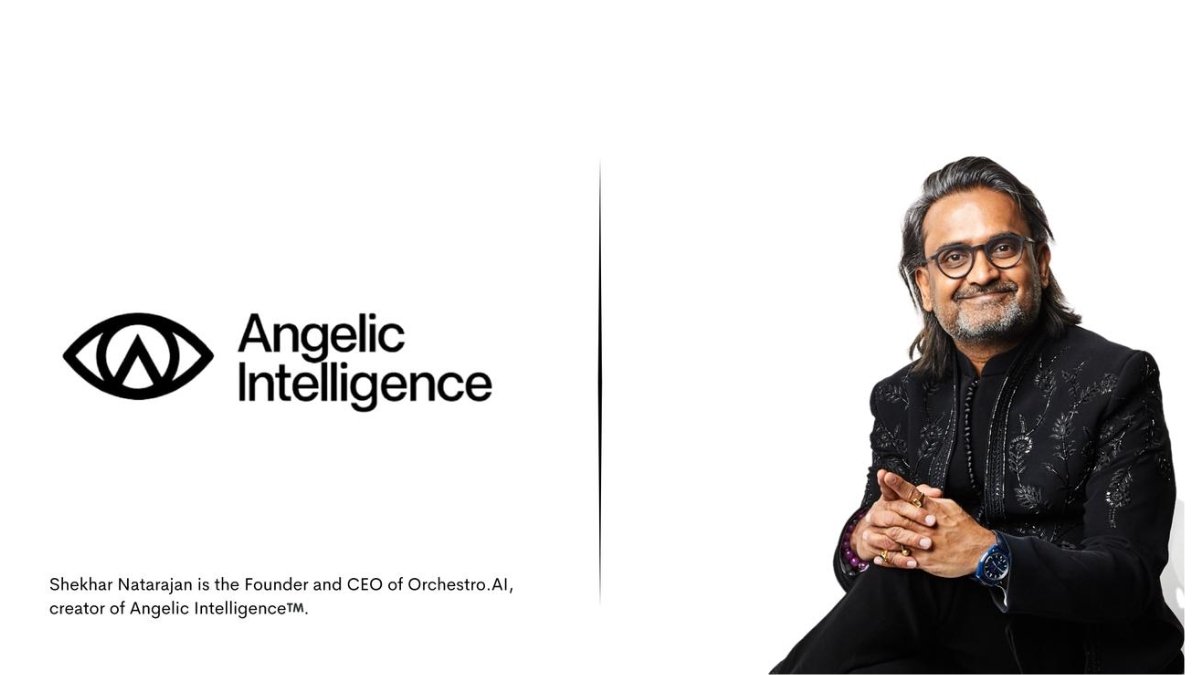
Shekhar Natarajan is the Founder and CEO of Orchestro.AI, creator of Angelic Intelligence . Davos 2026 opening keynote. Tomorrow, Today podcast (#4 Spotify). Signature Awards Global Impact laureate. 300+ patents. Georgia Tech, MIT, Harvard Business School, IESE. Grew up in a one-room house in the slums of Hyderabad. No electricity. Father earned $1.75/month on a bicycle. Mother stood outside a headmaster’s office for 365 days. One son, Vishnu. Paints every morning at 4 AM. Does not appear in the Epstein files.
If you object to the content of this press release, please notify us at pr.error.rectification@gmail.com. We will respond and rectify the situation within 24 hours.