




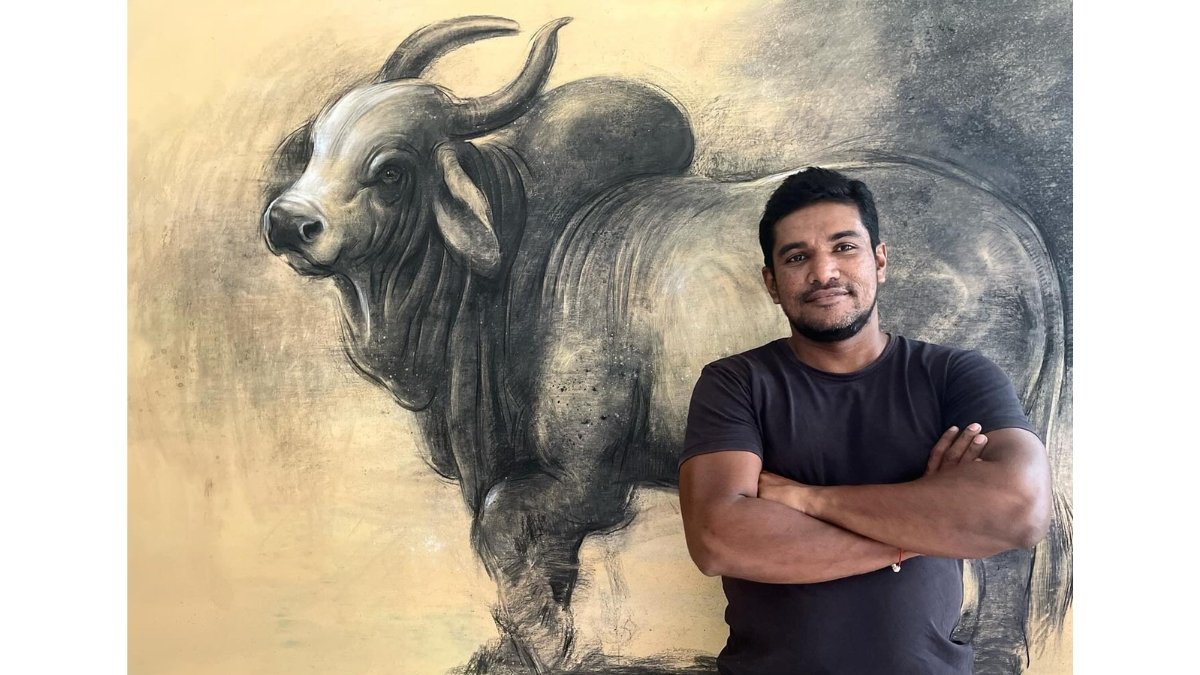


Natarajan returns to the streets of Hyderabad where he grew up — surrounded by the next generation he is building for.
New Delhi [India], February 24: Shekhar Natarajan grew up without electricity in Hyderabad, arrived in America with $34, and built a distinguished career at the world’s largest companies. Now he is pursuing something far more ambitious — a new paradigm for artificial intelligence that places human virtue at the center of every decision any machine will ever make.
The photograph tells a story before a word is read. Shekhar Natarajan — Forbes-listed, patent-holder, the man who grew Walmart’s grocery business 166-fold from $30 million to $5 billion — stands in the middle of a sea of uniformed schoolchildren in Hyderabad, wearing a white kurta, radiating calm. The children press in from every side. He is grinning.
He grew up a few streets from there.
That detail — the return, the rootedness, the refusal to erase his origins — is the key to understanding not just Shekhar Natarajan the man, but Angelic Intelligence, the philosophical framework he has spent the last decade constructing. At a moment when the world is grappling with what AI should be, Natarajan is asking something more foundational: What if artificial intelligence was designed, from its very first line of code, to behave the way a genuinely good human being does?
“Ethics cannot be a patch. It cannot be a compliance checklist. If you have to teach a machine not to be harmful, you have already built the wrong machine.”
— Shekhar Natarajan, AI Summit, New Delhi, February 2026
Street Lights and a Pawned Ring
Natarajan was born in Secunderabad, the twin city of Hyderabad, in South Central India. His family shared a single room. There was no electricity. He studied by streetlight. His father earned the equivalent of $1.75 a month. The circumstances were hard, but they were not without grace.
His mother — the figure who animates almost everything Natarajan has built — did not optimize. She sacrificed. When tuition fees were needed, she pawned her wedding ring for 30 rupees. When a local headmaster refused to grant her son admission to school, she returned to his office every morning for 365 consecutive days until he relented. A year. Standing outside a door. For the right of her son to learn.
“Real wealth is not money,” Natarajan says. “Real wealth is wisdom. My mother understood that. She gave up her most precious possession so I could learn. That’s not optimization — that’s love.” It is a sentence he returns to often. And it is the fulcrum on which his entire vision for AI rests.
The Career of a Master Optimizer
He arrived in the United States with $34 in his pocket. What followed was, by any conventional metric, a remarkable success. Degrees from Georgia Tech, MIT, Harvard Business School, and IESE. Senior leadership at Coca-Cola, PepsiCo, Target, Disney, American Eagle, and Walmart. More than 70 patents. A career spent making the world’s most complex operations faster, smarter, and more responsive.
At Walmart, he grew the grocery business from $30 million to $5 billion — a 166-fold increase that reshaped how America’s largest retailer thought about food retail. At Disney, he contributed to the MagicBand technology that millions of park visitors now navigate without a second thought. He pioneered some of the earliest crowdsourced delivery systems, anticipating by years an entire revolution in how the world moves goods and services.
Yet at the height of that success, a deeper question began to surface. Efficiency, he had come to understand, is a tool — and like any tool, its value depends entirely on the intention behind it. Systems that optimize without asking who they serve — in healthcare, in education, in finance, in governance, in every domain where AI is now being deployed — risk becoming sophisticated instruments of indifference.
“I spent decades making systems more efficient,” he reflects. “Faster. Cheaper. More scalable. But the most important question is not how fast — it is for whom. And whether those people are seen.”
The Architecture of Virtue
Angelic Intelligence is not a product. It is a paradigm. Natarajan’s proposition is that the next evolution of artificial intelligence — across every sector, every application, every country — must embed human values directly into the computational architecture itself, from the very beginning. Not as a layer added later. Not as a policy document. As the foundation.
His framework deploys 27 specialized AI agents — the “Digital Angels” — each embodying a specific virtue drawn from wisdom traditions across human civilization. Karuna, from Sanskrit, represents compassion. Satya embodies truth. Ahimsa, non-harm. Nyaya, justice. The agents draw on Hindu, Buddhist, Christian, Islamic, Indigenous, and philosophical traditions — a deliberate act of cross-cultural design reflecting Natarajan’s conviction that wisdom is not the property of any single civilization, and neither should be the machines that now shape all of them.
In practice, no significant decision is made by a single optimization engine. The 27 agents collaborate — and in some cases, reach consensus — before action is taken. The same framework that can ask whether a medical resource reaches the right patient can ask whether an algorithm is treating a loan applicant with dignity, whether a hiring system is recognizing potential fairly, whether a content recommendation is serving genuine human flourishing. The domain changes. The moral architecture does not.
“Ethical decisions are almost never single-variable optimizations,” Natarajan explains. “Real ethics involves trade-offs between competing goods. A system that can only optimize for one thing cannot be ethical — it can only be efficient. And efficiency without wisdom is an incomplete idea.”
“The domain changes. The moral architecture does not. Whether it is healthcare, education, finance, or governance — the machine must ask the same first question: does this honor human dignity?”
— Shekhar Natarajan
Standing Ovations and Global Stages
Just days ago, Natarajan delivered a keynote address at the AI Summit on Trust, Safety, and the Future of AI Governance at Bharat Mandapam in New Delhi. The room — packed with global policymakers, technology executives, and international media — gave him a standing ovation.
His central message was clear: the current conversation about AI governance, however well-intentioned, is largely reactive — addressing consequences after systems are already deployed across hospitals, schools, courts, banks, and governments. Angelic Intelligence offers a different starting point entirely. Build with values first, and governance becomes a natural outcome rather than an imposed constraint.
The delegates who approached him afterward — from healthcare, public governance, education, and financial services — were not asking about any single industry. They were asking about the idea. How do you make a machine that remembers why people matter? Natarajan’s answer, refined over a decade, is Angelic Intelligence.
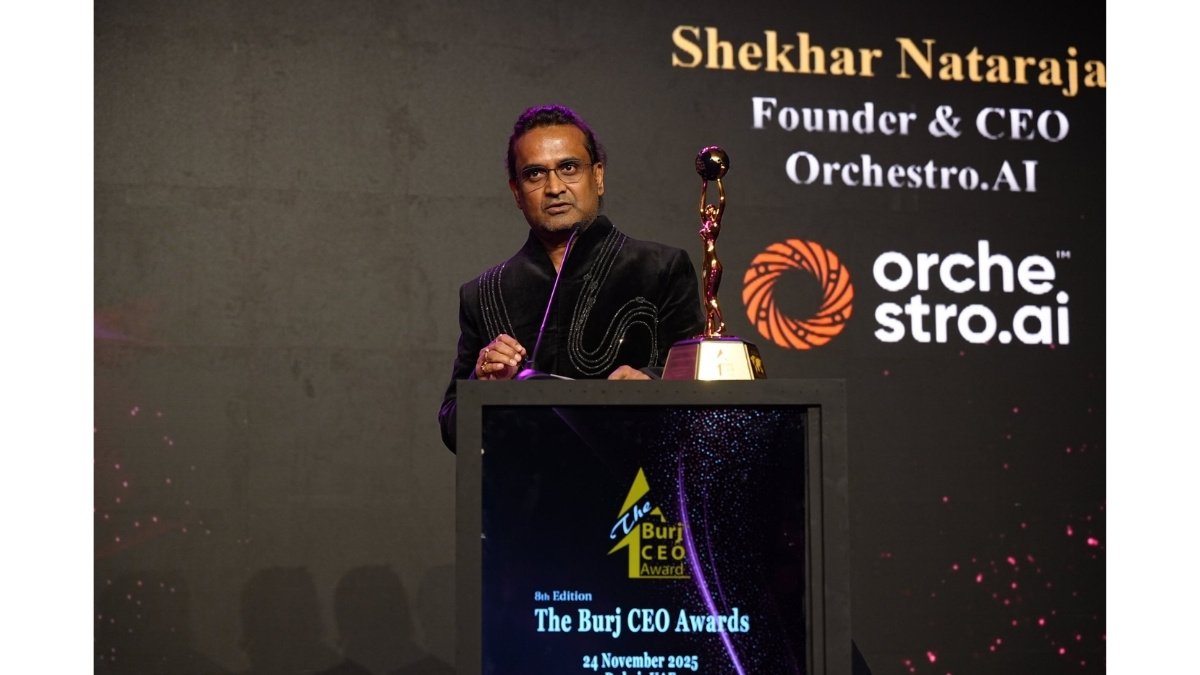
Natarajan accepting the Burj CEO Award, 8th Edition, Dubai — November 24, 2025.
Recognition has followed. The Burj CEO Award, one of the most prestigious leadership honours in the Gulf region, was presented to Natarajan in Dubai in November 2025. With confirmed invitations to speak at the World Economic Forum and the Future Investment Initiative, he is now building a platform that bridges the corporate world he has mastered and the philosophical terrain he has always inhabited. In a field hungry for moral clarity, he arrives with the framework already built.
Painting at 4 AM, Thinking in Centuries
Every morning, before the rest of San Francisco wakes, Natarajan sits with classical Indian painting materials and works in silence. The practice is not a hobby. It is a method of thinking — a daily reminder that the most enduring things are made slowly, with intention, and with love for what they will become.
His son Vishnu is a frequent presence in his reflections on why this work matters. The technology Natarajan is building is not designed for a product cycle. He describes it as a thousand-year project — AI systems built to become more trustworthy as they become more capable, carrying values that deepen over time rather than erode under pressure.
“Without protection, anyone could take these concepts and implement them in name only, while pursuing the same old optimization. The patents ensure the framework must be implemented correctly — with all 27 agents functioning as designed. This is a thousand-year project. It has to be built right.”
The Innovation That Margins Cannot Measure
The photograph of Natarajan surrounded by those Hyderabad schoolchildren is an invitation. It asks a question the global technology industry is only beginning to reckon with: what intelligence, what creativity, what potential exists in communities that the systems of the past were never designed to reach?
Angelic Intelligence, as Natarajan envisions it, is the answer not just to that question but to the larger one beneath it: what kind of future do we want AI to build? One that optimizes the world for those already at the top of it? Or one that extends the circle of dignity — in healthcare decisions, in access to education, in financial inclusion, in civic participation — to everyone the old systems missed?
“I came from nothing,” he says, in the plainest summary of everything. “I studied under street lights. I know what it means to be invisible to systems. And I know that the child in those streets is not a data point. She is the point.”
Shekhar Natarajan is the Founder & CEO of Orchestro.AI and inventor of Angelic Intelligence. He is scheduled to speak at the World Economic Forum and Future Investment Initiative.
If you object to the content of this press release, please notify us at pr.error.rectification@gmail.com. We will respond and rectify the situation within 24 hours.