







New Delhi: The space economy in India has quietly undergone a transformation in the last couple of years. For decades, the Indian Space Research Organisation (ISRO) was the sole authority in charge of the launching of satellites and deep space missions. A new generation of space startups is now emerging, taking on increasingly ambitious missions, after the sector was opened up to private involvement by policy reforms.
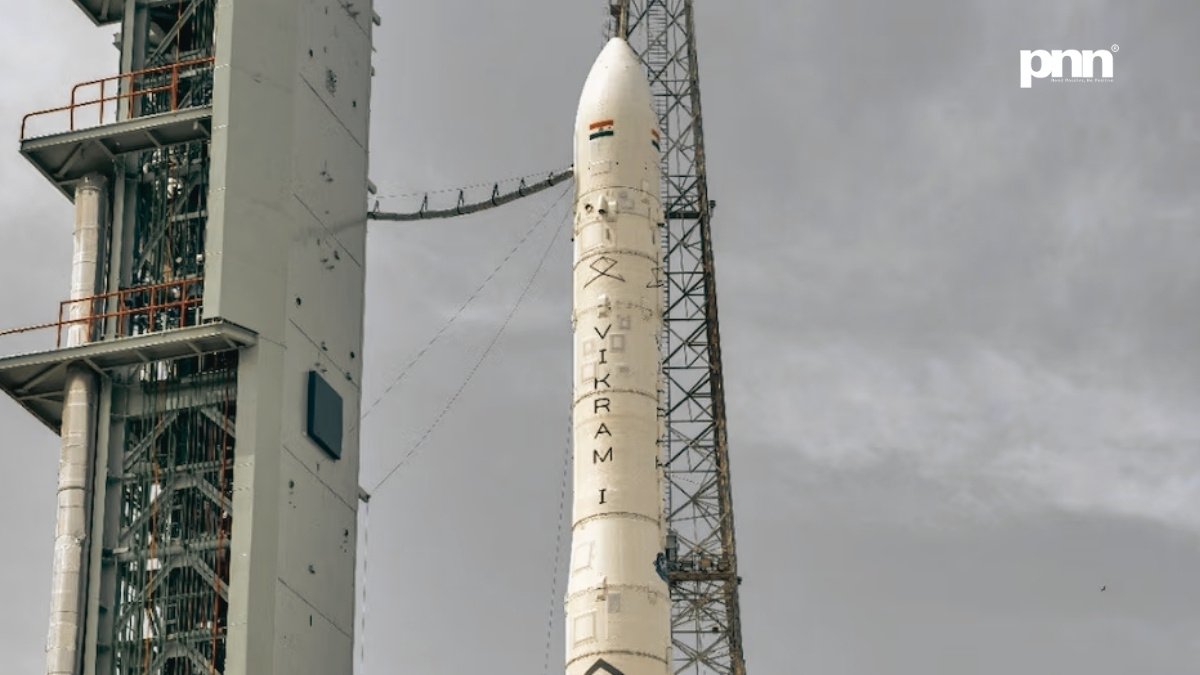
The change has taken a significant step forward on Saturday, as Skyroot Aerospace successfully launched Vikram-1, India’s first private orbital-class rocket, from Satish Dhawan Space Centre (SDSC-SHAR) in Sriharikota. Mission Aagaman is the maiden mission of the country by a private company to launch payloads into space with an indigenously developed launch vehicle.
The accomplishment is not just a single launch. It marks the evolution of the commercial space industry in India, where private industry is transitioning from technology demonstration to developing launch systems that may one day be able to compete in the global small satellite market.
Hyderabad-based Skyroot Aerospace, founded by former ISRO scientists Pawan Kumar Chandana and Naga Bharath Daka in 2018, has been working on developing launch vehicles for small satellites, which have seen the steady growth of demand from commercial operators, research institutions and governments. The company first showcased its capabilities in 2022 when it launched India’s first privately built rocket to space on a suborbital mission, Vikram-S. The next step in that journey is Vikram-1, the company’s next generation suborbital to orbital vehicle.
The Vikram-1 is a small satellite launch vehicle, unlike the large launch vehicles built for heavy satellites. The rocket is approximately 22 metres tall, has three solid propulsion stages, a liquid-fuel Orbital Adjustment Module and can lift up to 350 kilograms of payload to low Earth orbit. Carbon composite structures are also used to reduce the weight of the vehicle and improve efficiency.
Like most maiden flights, the mission Aagaman is a technology validation mission. The goal is not just to gather flight data for commercialization, but to gather flight data on propulsion, stage separation, guidance, navigation, avionics and vehicle performance. Data collected during the mission will be used to further refine the launch before Skyroot starts regular commercial operations.
The mission also featured several technology demonstration payloads from Indian and international customers, showcasing the increasing confidence in India’s burgeoning private launch industry. The payloads are satellites and in-orbit technology demonstration developed by Skyroot, Grahaa Space and German aerospace company DCUBED.
The launch also highlights the impact of India’s space sector reforms announced in 2020. The establishment of Indian National Space Promotion and Authorisation Centre (IN-SPACe) allowed private entities to avail ISRO facilities, get involved in the launch process and build their own commercial space capability. Since then, dozens of startups have come in, from launch vehicles to satellite production, to Earth observation and downstream applications.
The industry community feels that this wider ecosystem is necessary if India is to win a bigger stake in the global space economy. ISRO will be continuing to fly national scientific and strategic missions while the private sector is expected to take up the increasing demand for commercial launch services and satellite-based applications.
Prime Minister Narendra Modi said the mission is a “historic new frontier” for the Indian space programme, pointing to India’s burgeoning innovation ecosystem and the increased contribution of the private sector to high-tech areas.
Vikram-1 is not the end for Skyroot Aerospace, but rather the start of a bigger commercial plan. The company is looking to undertake more developmental flights before beginning commercial launch services and developing a family of launch vehicles to meet customer needs.
In many ways, the significance of Vikram-1 extends beyond the rocket itself. It shows that India’s private space industry is taking the next step from experimentation to execution. Future missions could capitalize on this momentum and bolster the country’s role in the rapidly expanding global small satellite market, and provide new opportunities for domestic space technology firms.