








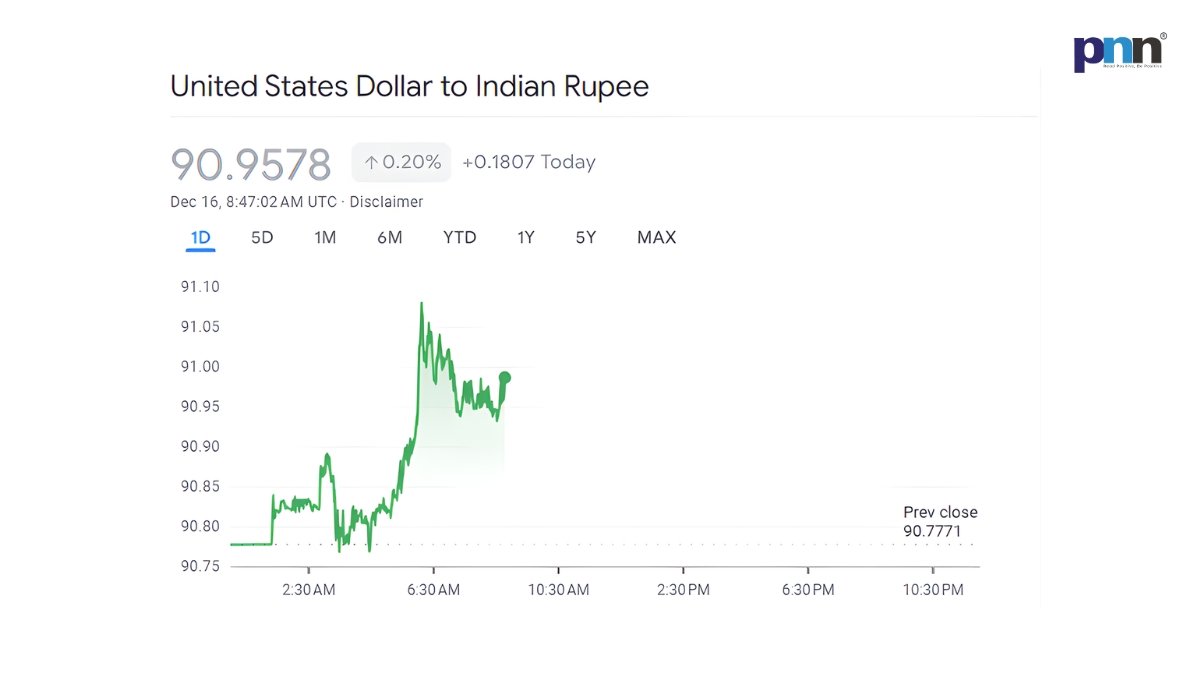
Mumbai (Maharashtra) [India], December 16: The Indian rupee has crossed 91 against the U.S. dollar. That single number is now echoing across bonds, stocks, and investor confidence.
What began as a currency wobble has morphed into a broader market warning. Both foreign and domestic investors are reassessing risk, and equities are feeling the heat.
Indian equities are clearly feeling the strain. Both benchmark indices opened lower and never found their footing through the session. The SENSEX slid more than 500 points intraday, while the NIFTY 50 slipped below the psychologically important 26,000 mark. Selling pressure wasn’t selective either. Midcap and smallcap stocks joined the fall, underlining how risk appetite has thinned across the board.
Three forces are doing the damage. Foreign institutional investors continue to pull money out, draining liquidity at a time when the market needs stability. The rupee’s slide to a fresh record low past 91 to the dollar is amplifying concerns around returns and capital preservation. Add weak global cues, with Wall Street under pressure and Asian markets opening soft ahead of key U.S. data, and the mood turns defensive fast. Most sectors are in the red, with private banks, metals, and IT bearing the brunt.
The Rupee Breaks a Psychological Barrier
The Indian rupee touched a fresh record low, breaching the 91-per-dollar mark. This is not just another data point. It’s a psychological crack in a currency long marketed as Asia’s most stable.
Pressure on the rupee is colliding with tightening domestic liquidity. Foreign investors are wary of currency losses. Local investors are uneasy about funding stress. Together, they are pulling risk appetite out of the market.
According to Systematix Institutional Equities, the rupee’s 6.6 percent slide this year is not a cyclical blip. It is the culmination of a decade-long, carefully managed depreciation. Since trading near 48/USD in 2012, the rupee has lost roughly 90 percent of its value.
Despite aggressive intervention, stability has been more cosmetic than real.
From Managed Stability to Structural Drift
Since 2017, the rupee has depreciated at an average of about four percent annually. That pace, analysts say, may no longer hold.
Systematix argues that structural weaknesses, fading RBI firepower, and a more protectionist global trade environment point to a new reality. A 6–7 percent annual depreciation may become the norm. On that trajectory, USD/INR could drift toward 100 over the next 12 to 24 months.
That’s not a forecast built on panic. It’s arithmetic layered on structural stress.
The rupee has also underperformed both the broad U.S. dollar index and emerging market currency benchmarks. In other words, this isn’t just about a strong dollar. It’s about India-specific fragility.
Why the Pressure Refuses to Ease
The pressure intensified after U.S. President Donald Trump’s tariff announcements. Currency weakness accelerated in the fourth quarter of the calendar year, even as the RBI stepped in.
A widening current account deficit appears to be the key culprit.
Emkay Global points to a two-front assault on the rupee. Exports weakened in Q4 as shipments were front-loaded earlier in the year before tariffs kicked in. At the same time, festival-season consumption boosted imports.
Add elevated gold imports to the mix and the external account starts to groan.
This is where the story turns uncomfortable.
Current Account, Capital Flows, and a Fragile Balance
Historically, the INR/USD pair has moved in lockstep with India’s current account deficit. As the CAD widens, the rupee tends to weaken. Capital flows usually offset this. Not anymore.
Capital inflows, once India’s shock absorber, have thinned dramatically. Total capital flows as a share of GDP have collapsed from 8.8 percent in FY08 to just 0.4 percent in FY25.
Even more striking is foreign direct investment. Net FDI as a percentage of GDP has shrunk to 0.02 percent in FY25. That’s the lowest reading on record.
Yes, the CAD excluding transfers has narrowed over the past decade, falling from 4.1 percent to 2.1 percent after peaking at 6.7 percent in FY13. But Systematix offers a blunt diagnosis. This is not evidence of external strength.
Instead, it reflects chronic domestic demand weakness, masked by headline growth numbers and a persistent absence of private investment.
In plain terms, India isn’t exporting its way to strength. It’s importing less because demand is soft.
Why Indian Rupee Depreciation Matters for Equities
This is where equity investors need to pay attention.
A weaker rupee, sticky bond yields, and slowing earnings growth form an awkward trio. Together, they cap broad market returns.
Systematix expects muted equity performance, with gains increasingly concentrated in specific pockets rather than across the index.
Sectors that benefit from INR/USD depreciation include information technology, pharmaceuticals, automobiles, and metals. Dollar-linked revenues and export exposure provide a natural hedge.
On the other side, banks, public sector enterprises, oil and gas companies, energy, and infrastructure players face pressure. Higher input costs, funding stress, and balance sheet sensitivity weigh them down.
The days of easy, broad-based rallies look numbered.
Defensive Positioning Takes Center Stage
Emkay Global is even more cautious in the near term. Continued stress on the external account, it says, keeps sentiment fragile.
The brokerage believes the only durable solution to this negative loop would be a comprehensive India–U.S. trade deal, including meaningful tariff reductions for Indian exports.
Until then, markets remain vulnerable to periodic sell-offs. Equities will not be immune to global contagion.
Over the next few months, Emkay advises increasing defensive exposure. Technology, pharmaceuticals, and private banks stand out due to their historically lower beta. Small- and mid-cap exposure, on the other hand, should be trimmed given high volatility and stretched valuations.
This isn’t fear-mongering. It’s risk management.
Is This Just a Passing Phase?
Emkay does offer a measured dose of optimism. It views the current volatility as a passing phase, assuming the trade deal concludes within three to six months.
There are green shoots. Domestic economic momentum is improving. The earnings cycle has shown signs of turning over the past month or two.
From a long-term perspective, Emkay remains constructive on Indian equities, with consumer discretionary as its most preferred sector.
Still, optimism comes with a valuation warning.
Valuations Leave Little Room for Error
Systematix strikes a sharper tone on valuations. With slowing earnings growth, a currency-adjusted price-to-earnings ratio of 21–23 times, and a market cap-to-GDP ratio hovering around 128 percent, India looks expensive.
Relative to most global markets, particularly China, Indian equities are priced for perfection.
In an environment of Indian rupee depreciation and fading capital inflows, perfection is a dangerous assumption.
The Bigger Picture India Can’t Ignore
As global protectionism deepens, India risks slipping into a self-reinforcing loop. A weaker rupee feeds inflation. Inflation tightens liquidity. Tight liquidity dents growth and earnings. That, in turn, scares capital away.
Breaking out of this cycle will require more than monetary tweaks.
Systematix is clear. The durable escape lies in reviving domestic investment and productively deploying India’s underutilized demographic potential. That means moving beyond overused counter-cyclical tools and pushing structural reforms with conviction.
Currency stability can be managed for a while. Growth credibility cannot.