






New Delhi [India], December 29: AYUSH medicines don’t float in regulatory limbo. They operate under a dense, rule-heavy system that most critics never bother to read. Here’s what actually keeps Ayurveda, Siddha, Unani and Homoeopathy drugs in check.
India’s AYUSH sector sits at an awkward crossroads. Hugely popular. Deeply traditional. Constantly questioned. What rarely gets attention is the regulatory scaffolding holding it together. It exists. It’s detailed. And it’s far from symbolic.
At the centre of this system is AYUSH drug quality regulation, a framework built on testing, surveillance, certification and enforcement. Let’s break it down without the fog.
PCIM&H and the Backbone of AYUSH Drug Quality Regulation
The Pharmacopoeia Commission for Indian Medicine and Homoeopathy, or PCIM&H, operates under the Ministry of Ayush. Its role is blunt and non-negotiable. It acts as the appellate drug testing laboratory for Ayurveda, Siddha, Unani and Homoeopathy drugs.
That means when quality disputes arise, PCIM&H is the final word on identity, purity, strength and composition. No opinions. Just lab results.
PCIM&H also publishes pharmacopoeial standards and formularies. These documents are not academic fluff. Under the Drugs and Cosmetics Act, 1940, compliance with these standards is mandatory for manufacturers. Miss them, and you are in violation of the law.
Drug Testing Laboratories and Rule 160 A to J
AYUSH drug quality regulation is anchored in Rule 160 A to J of the Drugs Rules, 1945. These rules govern how drug testing laboratories are approved to test Ayurvedic, Siddha and Unani medicines.
As of today, 34 State Drug Testing Laboratories have received central support to upgrade infrastructure and functionality. Beyond that, 108 laboratories are officially approved or licensed to test AYUSH drugs and raw materials.
Add to this three Regional Research Institutions under the Central Council for Research in Ayurvedic Sciences, approved under Rule 160E. These labs aren’t decorative. They are legally empowered testing bodies.
Pharmacovigilance for AYUSH Drugs Isn’t Optional
AYUSH drug quality regulation doesn’t stop at manufacturing. It extends into the market.
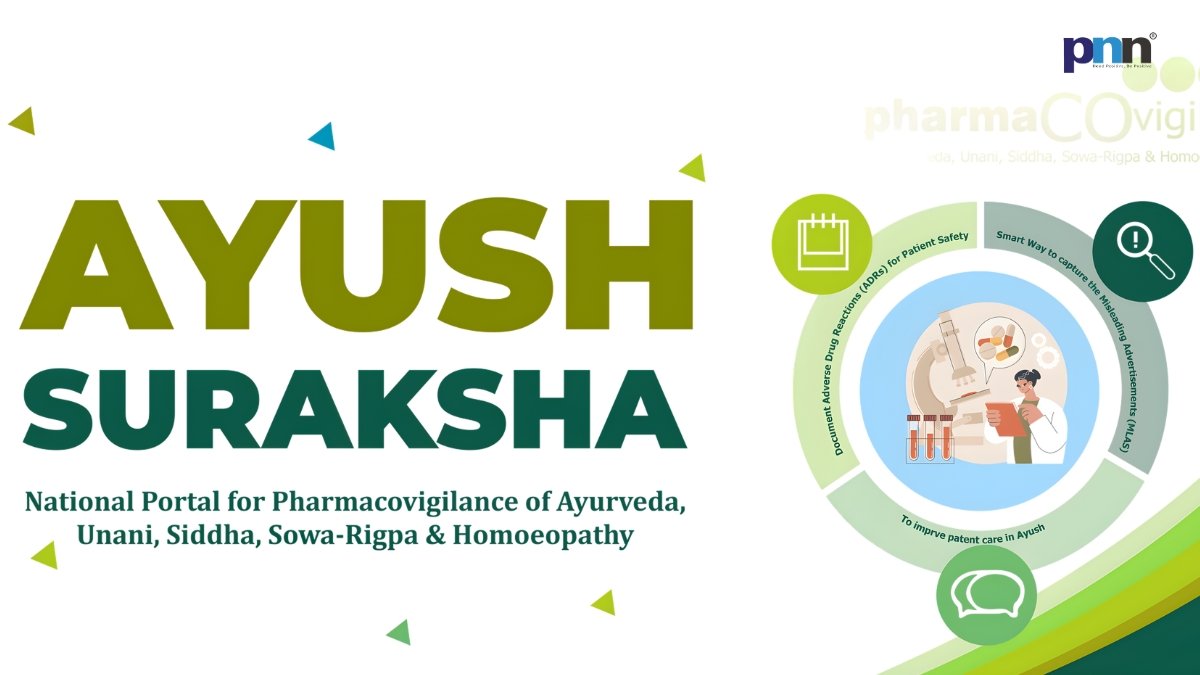
Under the Central Sector Scheme Ayush Oushadhi Gunavatta Evam Uttpadan Samvardhan Yojana, or AOGUSY, India runs a nationwide pharmacovigilance programme for AYUSH drugs.
The structure is three-tiered:
- One National Pharmacovigilance Centre.
- Five Intermediary Centres.
- Ninety-seven Peripheral Centres spread across the country.
Their mandate is simple. Monitor adverse reactions. Track misleading advertisements. Report violations to State Regulatory Authorities for action.
So far, this network has conducted 3,533 awareness programmes, reaching over 3.18 lakh beneficiaries. That’s not passive regulation. That’s boots on the ground.
Cracking Down on Misleading Claims

One of the loudest criticisms of AYUSH products is exaggerated advertising. The system acknowledges that risk and actively targets it.
Pharmacovigilance centres are specifically tasked with identifying misleading advertisements. When found, these are escalated to state regulators. Enforcement follows existing legal provisions. No parallel justice. No shortcuts.
The objective is consumer protection. Plain and simple. Verified claims stay. Unverified ones don’t.
Global-Grade Certifications for AYUSH Products
AYUSH drug quality regulation also looks outward.
India extends the World Health Organization’s Certification of Pharmaceutical Product, or CoPP, scheme to Ayurvedic, Siddha and Unani medicines. This certificate is administered by the Central Drugs Standard Control Organisation.
The process includes joint inspections by CDSCO, the Ministry of Ayush and State Licensing Authorities. It’s not a paperwork exercise. Manufacturing units are physically inspected.
Separately, the Quality Council of India runs a Quality Certification Scheme. Products meeting domestic and international standards receive the Ayush Mark, based on third-party evaluation.
That’s how export credibility is built. Slowly. Methodically.
AOGUSY and the Money Behind Quality
Regulation without funding collapses. The Ministry of Ayush knows this.
Under AOGUSY, the government has allocated Rs 122 crore over five years, from 2021–22 to 2025–26. One key component focuses on upgrading AYUSH pharmacies and drug testing laboratories.
Better equipment. Better compliance. Fewer excuses.
Legal Architecture of AYUSH Drug Regulation
The Drugs and Cosmetics Act, 1940 doesn’t treat AYUSH as an afterthought. It has exclusive chapters and schedules for it.
Ayurveda, Siddha, Sowa-Rigpa and Unani drugs fall under Chapter IVA and Schedule I of the Act, along with Rules 151 to 169 and Schedules E(I), T and TA.
Homoeopathic drugs are governed by a separate set of provisions, including Schedule 4A of the Act and multiple rules and schedules under the Drugs Rules, 1945.
Manufacturers must comply with Good Manufacturing Practices under Schedule T. Proof of safety and effectiveness is mandatory. There’s no opt-out clause.
CDSCO’s AYUSH Vertical and Inspections
To tighten enforcement, the Ministry of Ayush has established a dedicated AYUSH vertical within CDSCO.
This unit conducts inspections of manufacturing facilities in coordination with state drug inspectors and licensing authorities. The goal is consistent enforcement across states, not regulatory patchwork.
Think of it as centre-state teamwork with lab coats.
Research, Validation and the Ayurgyan Scheme
Quality regulation isn’t complete without research.
Since 2021–22, the Ministry of Ayush has implemented the Ayurgyan Scheme to support research and innovation. It has three components:
– Capacity building and continuing medical education.
– Research and innovation.
– Ayurveda Biology Integrated Health Research.
This feeds directly into scientific validation, not belief-based promotion.
Research Councils and Scientific Oversight
India has established dedicated research councils for Ayurveda, Unani, Homoeopathy, Siddha, and Yoga and Naturopathy. These bodies coordinate national research on medicinal plants, drug standardisation, pharmacology, clinical studies and tribal healthcare.
Their work is conducted through institutes across the country and in collaboration with universities and hospitals.
PCIM&H also runs regular training programmes for state regulators, lab personnel and quality control staff. Regulation improves when people actually know the rules.