






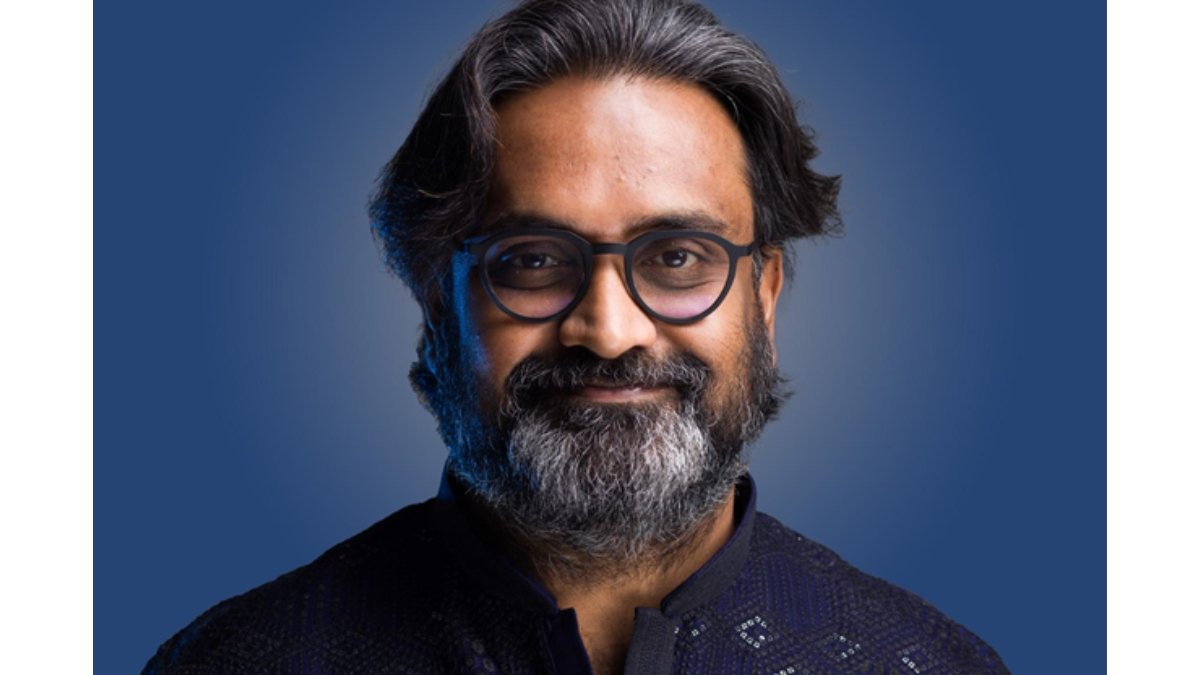
Before there were patents and billion-dollar supply chains, there was a woman standing outside a headmaster’s office. Every morning. For a year. Shekhar Natarajan is still running the code she wrote.
Hyderabad (Telangana) [India], February 27: The school uniform is plaid — the kind of cheap synthetic fabric that softens with age, that every laundry cycle softens a little more until it starts to look like something worn with love rather than worn out. A hundred children are wearing it on this particular morning in a courtyard of cracked concrete in one of Hyderabad’s underserved settlements. They’ve crowded around a tall man in a white kurta, pressing against his arms, some reaching up to touch his sleeve, the way children everywhere test whether a visitor is real or just passing through.
Shekhar Natarajan, 45, does not look like a man who holds more than seventy patents. He does not look like someone who transformed a $30 million grocery operation into a $5 billion business for Walmart, or who is preparing, in a matter of weeks, to address the World Economic Forum on the future of artificial intelligence. What he looks like, standing in this courtyard, is someone who grew up somewhere very much like this.
Which is, of course, exactly the point.
I. The Founding Investment
There is a specific kind of financial transaction that economists do not study: the pawning of a wedding ring to pay a school fee. It is not venture capital. It is not seed funding. It does not appear in any balance sheet or pitch deck. But Natarajan will tell you, if you ask him the right question, that it is the foundational investment behind everything he has built.
His mother — a woman from South Central India whose name he invokes with a particular quality of stillness — sold her wedding ring for thirty rupees when the family needed to fund his education. Thirty rupees. In today’s money, the kind of amount that wouldn’t buy you a cup of filter coffee in the Hyderabad café district. In the economy of sacrifice, it was everything.
But the money was only the half of it. The other half was time.
“She stood outside the headmaster’s office,” Natarajan says. “Every day. For three hundred and sixty-five days. Not because she had an appointment. Not because she had leverage. Because she had decided that this was where she would stand until something changed.”
He pauses here, in the way of a man who has told this story many times and has still not found words adequate to it.
“I don’t know another word for that except love. That kind of love is not a feeling. It is a technology. It produces outcomes.”
“She didn’t have power. She didn’t have access. She just had a decision. I’ve been trying to build AI systems with that same architecture ever since.”
II. The $34 Suitcase
He arrived in America with thirty-four dollars. He does not say this for drama — or not primarily for drama. He says it because he believes it is a data point, evidence in an argument he has been constructing for three decades: that the circumstances of a person’s origin tell you almost nothing about the ceiling of their potential, and that any system — political, institutional, technological — that treats origin as destiny is not just unjust but functionally stupid.
From thirty-four dollars, Natarajan built a career that took him through Georgia Tech, MIT, Harvard Business School, and IESE, and then into senior roles at some of the most recognizable consumer brands in the world. The man who grew up watching his mother stand in a corridor for a year would eventually help architect a logistics transformation at Walmart that moved nine-figure grocery revenues to ten-figure ones. He would contribute to innovation at Disney. He would accumulate patents — over seventy of them — the way some people accumulate degrees.
But the career, as impressive as it is on paper, is not the story he is trying to tell. It is the context for the story he is trying to tell.
“Every system I worked inside,” he says, “was optimizing for the wrong thing. Faster, cheaper, more efficient — yes. But more human? More dignified? That wasn’t in the KPIs. And I kept thinking: we have the most powerful technology in human history, and we’re using it to serve people who are already served.”
III. What Silicon Valley Gets Wrong
The artificial intelligence industry, in Natarajan’s view, has a fundamental architectural flaw — and it is not a technical one.
“The flaw is philosophical,” he says. “Every major AI system is built with ethics as a constraint. You build the system first, optimize it for performance, and then someone in a governance meeting asks: ‘wait, is this fair? Is this safe? Does this harm people?’ And then you bolt on a filter. You put guardrails on the outside.”
He leans forward. This is clearly a distinction that matters to him with almost physical intensity.
“My mother did not put compassion on the outside of her decisions as a filter. It was the decision. The love was the architecture, not the guardrail. That is what I am trying to build.”
He calls it Angelic Intelligence — a framework built on what he describes as virtue-native AI, where ethical reasoning is not applied after the fact but embedded in the computational substrate itself. His 27 Digital Angels, a framework drawing on cross-cultural traditions of virtue from Confucian ethics to Ubuntu philosophy to the Vedantic concept of dharma, are not filters on top of a system. They are, in his formulation, the system.
The concept will be tested. Every ambitious framework in AI eventually meets the grinding specificity of the real world — the edge cases, the adversarial inputs, the competing stakeholder interests. Natarajan knows this. He has spent enough time in Fortune 500 boardrooms to understand the distance between a compelling idea and a deployed technology.
“The companies building AI fastest are not asking what it should be. They are asking what it can do. Those are not the same question.”
IV. The Boy in the Courtyard
Back in the courtyard, a girl — maybe eight years old, her uniform slightly too big for her, sleeves rolled up — has taken his hand. He has stopped mid-sentence in conversation with a visiting journalist. He kneels down.
They look at each other for a moment that is longer than it should be, given that they have never met. She has the unsentimental gaze of a child who has learned to take the measure of adults quickly.
He says something to her in Telugu. She says something back. He laughs.
“She told me my shoes are dirty,” he translates, standing up.
They are. He has walked through the settlement’s unpaved lanes to get here, and his leather shoes are coated in the reddish-brown dust that is, in some sense, the geological record of this part of the city.
He doesn’t seem bothered. He looks, if anything, pleased.
“Children here see everything,” he says. “They miss nothing. The question is only whether the world will build systems that see them back.”
V. A Thousand-Year Problem
Every morning at 4 AM — before the technology industry wakes up, before the markets open, before the conference calls begin — Shekhar Natarajan paints. Classical Indian forms. He has done this for years. It is, he explains, less a hobby than a discipline of attention.
“Painting teaches you that the good things take time,” he says. “There is no shortcut in a brushstroke. The hand learns slowly. The eye learns slowly. Wisdom accumulates like sediment.”
He is preparing to speak at Davos and at the Future Investment Initiative in Riyadh — rooms full of the people who will make decisions about AI’s trajectory over the next decade. His message there will be, in essence, the same as his message in this courtyard: that the technology being built right now is making choices about who gets to be seen, and those choices have consequences that will outlast the quarterly earnings cycle by several centuries.
“The Indian intellectual tradition thinks in ten-thousand-year cycles,” he says. “Silicon Valley thinks in eighteen-month product roadmaps. Somewhere in between those two timeframes is the actual problem.”
He is, it should be said, not without self-awareness about the scale of his ambition — or its risks. He is building a company, not just a philosophy. The patents are real. The business models are real. The gap between virtue-native AI as concept and virtue-native AI as deployed infrastructure is real and large and requires capital and engineering talent and enterprise customers.
He talks about all of this without apparent anxiety, which is either the equanimity of a man who has made peace with uncertainty or the confidence of one who has been in harder rooms than a venture capital pitch meeting. Given the biography, both seem plausible.
“I left India with thirty-four dollars. I’ve been in deficit before. The question is not what you start with. The question is what you are oriented toward.”
Coda: The Boomerang
An hour after arriving, Natarajan is preparing to leave. The children have mostly dispersed back into their classrooms. The courtyard is quieter now, just a few stragglers and the low sound of a lesson being conducted somewhere inside the building.
He stops at the gate. Looks back.
“My parents sent something into the world,” he says, not to the journalist exactly, more to the general air of the place. “My mother with her ring and her three hundred and sixty-five mornings. My father with his quiet generosity. They sent it forward. And it came back to me — as opportunities, as mentors, as the people who appeared exactly when I needed them to appear.”
He is quiet for a moment.
“Now I have to send it forward again. That is all this is. That is what Angelic Intelligence is. The ring my mother pawned — I’m trying to give it back. A million times over. In a form she never could have imagined but would immediately recognize.”
He walks out through the gate. Behind him, through the window of a classroom, a girl is writing something on a chalkboard.
She doesn’t know a man just stood in her courtyard who grew up somewhere very much like this place, who left with thirty-four dollars, who came back decades later convinced that the most important thing he could build was not a faster supply chain or a more efficient algorithm, but something that learned — structurally, computationally, irreversibly — to see people like her.
She’s just doing her homework.
But the room she’s sitting in has electricity now. And somewhere, invisibly, a technology is being designed that might one day look at her and decide she is worth seeing.
Her mother’s sacrifice — whatever form it took, whatever ring she may have pawned or corridor she may have stood in — is already in the system.
That’s the bet, anyway.
If you object to the content of this press release, please notify us at pr.error.rectification@gmail.com. We will respond and rectify the situation within 24 hours.