






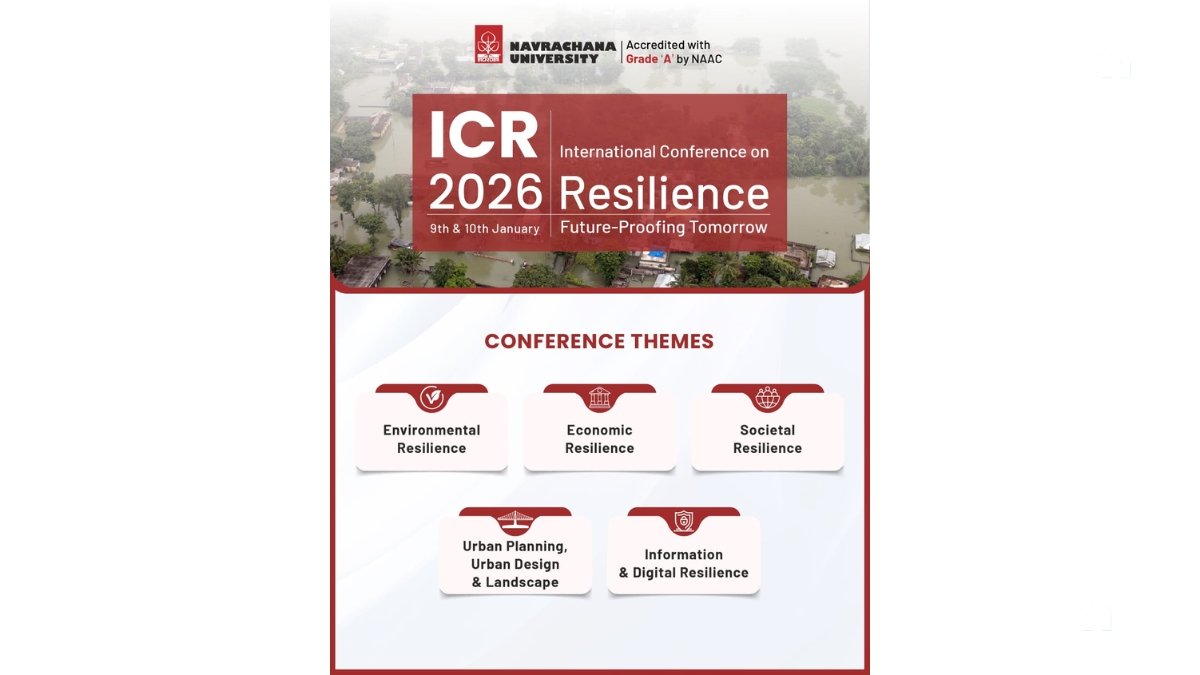
International Conference on Resilience (ICR 2026)
Vadodara (Gujarat) [India], January 5: For decades, sustainability has shaped how institutions, cities and communities think about growth and responsibility. While sustainability focuses on long-term balance and conservation, resilience responds to disruption, to shocks that are already unfolding and to uncertainties that cannot always be predicted. It is about the capacity to absorb stress, adapt in real time, and reorganise without losing core purpose. In today’s world of overlapping environmental, economic, digital and social challenges, resilience has emerged as a more immediate and action-oriented framework.
It is within this evolving understanding that Navrachana University’s International Conference on Resilience (ICR 2026) is positioned, not as a conventional academic exercise, but as a response to conditions that cities, institutions and societies are actively navigating.
The academic engagement with ICR 2026 reflects this urgency. Over 175 research abstracts have been received from universities, research institutions, industry organisations and independent practitioners across India and abroad, indicating a clear shift in scholarly focus, from ideal futures to adaptive strategies for present-day realities. All accepted and presented papers emerging from these submissions will be published as a Scopus-indexed book series by Springer Nature, further underscoring the academic significance and global visibility of the conference’s research outcomes.
Speaking about the record number of abstract submissions received for the conference, Prof. Pratyush Shankar, Provost, Navrachana University, said, “The diversity and volume of submissions reflect how resilience is being examined today through interdisciplinary lenses—bringing together environmental studies, urban planning, economics, digital systems and social inquiry. This range of perspectives reinforces the need to approach resilience not in silos, but as an interconnected and evolving field of study.”
What stands out equally is the geographical diversity of these submissions. Contributions have come from a wide spread of regions across India—including metropolitan centres, emerging cities and academic hubs—as well as from international institutions and organisations in countries such as the United States and Bangladesh. The presence of national institutes, schools of architecture and planning, universities, research councils, private studios, consultants and global technology and industry players underscores the conference’s reach beyond disciplinary and geographical boundaries, reinforcing resilience as a globally shared concern shaped by local realities.
The thematic breadth of the submissions mirrors the complexity of current challenges. Environmental resilience addresses the intensification of climate events and ecological stress, while economic resilience responds to instability in markets, livelihoods and supply chains. Other submissions examine how cities and institutions respond to rapid change through planning, governance and adaptive design, reflecting the evolving scope of resilience as a multidisciplinary concern.
These themes are not abstract. Vadodara’s own experiences with urban flooding, infrastructure pressure and heritage transformation offer tangible examples of how resilience differs from sustainability. While sustainability may ask how resources are preserved over time, resilience asks how cities function when systems fail, how communities recover after disruption, and how lessons are embedded into future planning.
While the floods of Vadodara provide an important starting point, the conference deliberately broadens the conversation to examine resilience across interconnected systems. ICR 2026 engages with environmental and climate resilience alongside urban infrastructure and planning responses, economic resilience in the face of market and livelihood disruptions, societal and institutional resilience shaped by equity and governance, and information and digital resilience amid growing technological dependence. Together, these sub-themes reflect the understanding that contemporary challenges rarely occur in isolation and demand integrated, cross-disciplinary
Vadodara, India, 5th January, 2026 – For decades, sustainability has shaped how institutions, cities and communities think about growth and responsibility. While sustainability focuses on long-term balance and conservation, resilience responds to disruption, to shocks that are already unfolding and to uncertainties that cannot always be predicted. It is about the capacity to absorb stress, adapt in real time, and reorganise without losing core purpose. In today’s world of overlapping environmental, economic, digital and social challenges, resilience has emerged as a more immediate and action-oriented framework.
It is within this evolving understanding that Navrachana University’s International Conference on Resilience (ICR 2026) is positioned, not as a conventional academic exercise, but as a response to conditions that cities, institutions and societies are actively navigating.
The academic engagement with ICR 2026 reflects this urgency. Over 175 research abstracts have been received from universities, research institutions, industry organisations and independent practitioners across India and abroad, indicating a clear shift in scholarly focus, from ideal futures to adaptive strategies for present-day realities. All accepted and presented papers emerging from these submissions will be published as a Scopus-indexed book series by Springer Nature, further underscoring the academic significance and global visibility of the conference’s research outcomes.
Speaking about the record number of abstract submissions received for the conference, Prof. Pratyush Shankar, Provost, Navrachana University, said – “The diversity and volume of submissions reflect how resilience is being examined today through interdisciplinary lenses—bringing together environmental studies, urban planning, economics, digital systems and social inquiry. This range of perspectives reinforces the need to approach resilience not in silos, but as an interconnected and evolving field of study.”
What stands out equally is the geographical diversity of these submissions. Contributions have come from a wide spread of regions across India—including metropolitan centres, emerging cities and academic hubs—as well as from international institutions and organisations in countries such as the United States and Bangladesh. The presence of national institutes, schools of architecture and planning, universities, research councils, private studios, consultants and global technology and industry players underscores the conference’s reach beyond disciplinary and geographical boundaries, reinforcing resilience as a globally shared concern shaped by local realities.
The thematic breadth of the submissions mirrors the complexity of current challenges. Environmental resilience addresses the intensification of climate events and ecological stress, while economic resilience responds to instability in markets, livelihoods and supply chains. Other submissions examine how cities and institutions respond to rapid change through planning, governance and adaptive design, reflecting the evolving scope of resilience as a multidisciplinary concern.
These themes are not abstract. Vadodara’s own experiences with urban flooding, infrastructure pressure and heritage transformation offer tangible examples of how resilience differs from sustainability. While sustainability may ask how resources are preserved over time, resilience asks how cities function when systems fail, how communities recover after disruption, and how lessons are embedded into future planning.
While the floods of Vadodara provide an important starting point, the conference deliberately broadens the conversation to examine resilience across interconnected systems. ICR 2026 engages with environmental and climate resilience alongside urban infrastructure and planning responses, economic resilience in the face of market and livelihood disruptions, societal and institutional resilience shaped by equity and governance, and information and digital resilience amid growing technological dependence. Together, these sub-themes reflect the understanding that contemporary challenges rarely occur in isolation and demand integrated, cross-disciplinary approaches.
Academic discussions at ICR 2026 draw from a body of scholarship that examines cities, environments and institutions as evolving systems shaped by historical, social and ecological forces. Rather than approaching resilience as a fixed outcome, this perspective treats it as a process—one that is continuously shaped by changing contexts, constraints and responses over time.
This academic orientation finds institutional expression in KHOJ, which serves as a conceptual anchor for ICR 2026. Through KHOJ, students and researchers engage directly with real-world challenges—such as urban flooding, ecological stress and habitat transformation—using observation, documentation and field-based inquiry. The initiative emphasises learning through practice, enabling students to study contemporary challenges and actively explore how resilience can be built, tested and refined in response to lived conditions.
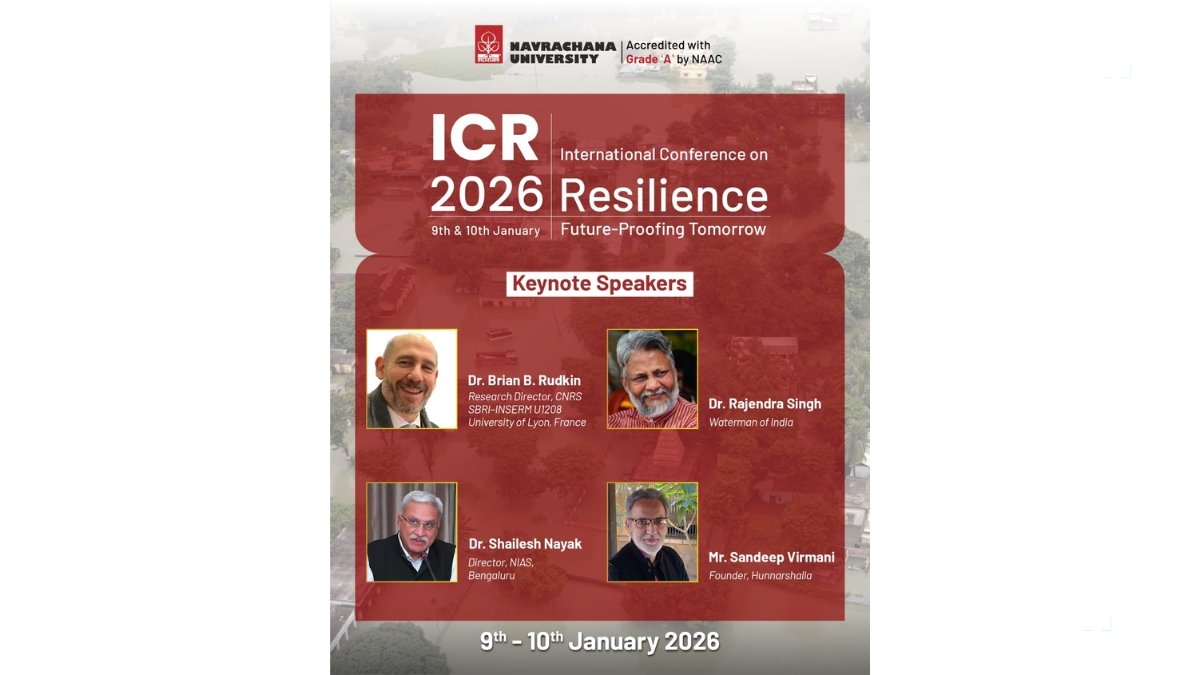
Adding further depth to the conference discourse is the presence of distinguished keynote speakers whose work spans science, policy, environmental governance and global sustainability practice. Dr. Rajendra Singh, also known as the Waterman of India, widely recognised for his grassroots-led water conservation efforts, brings insights into community-driven ecological resilience. Mr. Sandeep Virmani, an environmentalist trained in architecture and based in Kutch, brings a community-rooted, practice-led perspective on ecosystems, traditional knowledge and habitat resilience. Padma Shri Shailesh Nayak, a leading voice in earth sciences and coastal systems, offers a macro-level understanding of climate risks, ocean systems and long-term environmental preparedness.
Further strengthening the international dimension of the conference is the participation of Dr. Brian B. Rudkin, who will be joining from Lyon, France. Associated with One Sustainable Health, Dr. Rudkin brings global perspectives on sustainability, systems thinking and cross-sectoral resilience, enriching the conference dialogue with international practice-led insights. Together, their perspectives bridge practice, policy and science—strengthening the conference’s interdisciplinary foundation.
The International Conference on Resilience (ICR 2026) will be held from January 9 to January 10, 2026, at the Navrachana University campus, Vadodara. Over two days, the conference will bring together researchers, practitioners and institutional leaders to examine how resilience—distinct from conventional sustainability—can shape more responsive, adaptable and inclusive futures.
For more details – https://www.icr2026.com/
If you object to the content of this press release, please notify us at pr.error.rectification@gmail.com. We will respond and rectify the situation within 24 hours.