




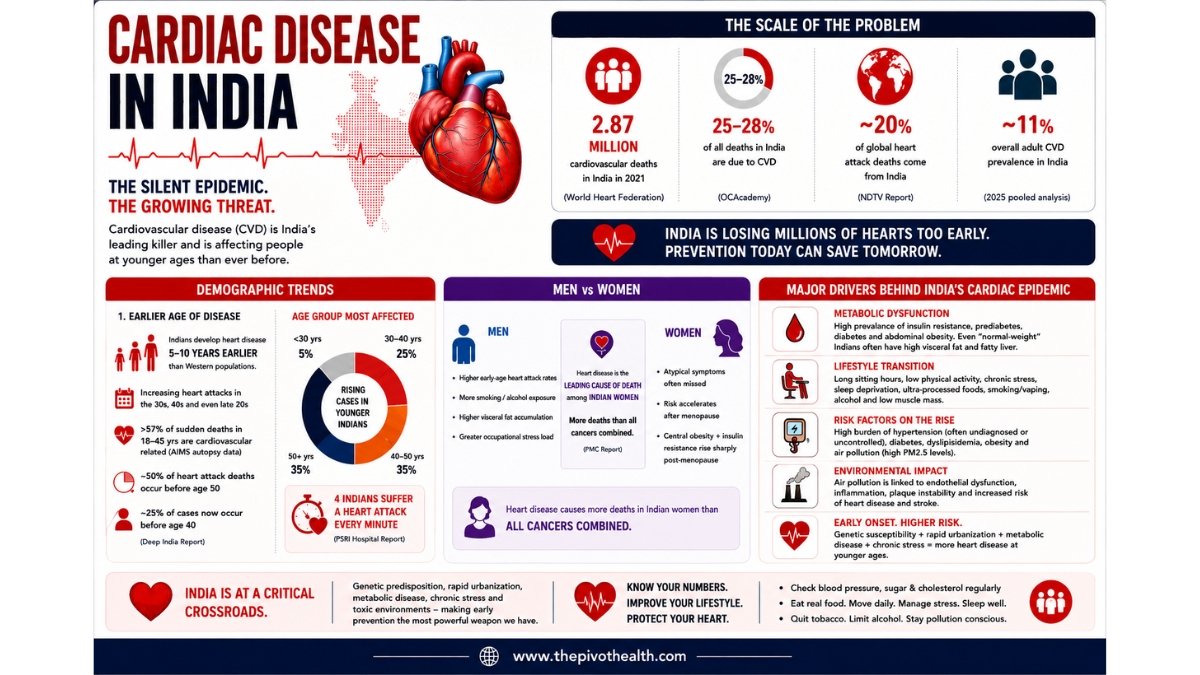
New Delhi [India], May 11: Every week in India, heart disease claims more than 59,000 lives. That is 350 people every hour dying in the country, accounting for 32% of all fatalities in 2023 alone, according to the Global Burden of Disease study.
These are not numbers that should surprise us anymore. And yet, the stories behind them still do.
A founder in his late 40s. A CFO who just passed his annual check-up. A senior executive whose cholesterol was “well within range.” We keep describing these events as sudden. They are not. What they are, almost without exception, is undetected. Stories like this are not unusual in India. They are, increasingly, the norm.
According to the Global Burden of Disease study (2025), 32% of all deaths in India in 2023 were caused by heart disease, or 350 every hour. More alarming is where these deaths are concentrated: urban, working-age professionals, with cardiac events now occurring almost a decade earlier in India than global averages. Many had no prior diagnosis. Several had normal reports.
The question a growing number of specialists are asking is not why these events happen. It is why they keep going undetected until it is too late.
The Gap Nobody Talks About
Ankur Bhatia spent over two decades in corporate leadership before he began asking that question seriously. What he observed — in colleagues, in peers, in the broader pattern of high-achievers who deteriorated quietly eventually led him away from the boardroom and toward a five-year deep dive into preventive cardiology, nutrition, lifestyle medicine, and the science of early risk detection.
In 2025, he founded The Pivot Health, a precision preventive health venture built around a single conviction: that the window between early biological dysfunction and an irreversible heart event is both measurable and actionable, and that the medical system, through no fault of its own, is structurally not designed for it.
“Most heart attacks are not sudden events. They are the result of years of silent accumulation. The body signals long before it breaks down. The tragedy is that we have built a system that only listens once something has already gone wrong.” — Ankur Bhatia, Founder, The Pivot Health
The problem, Ankur argues, is not that people are not getting check-ups. It is that the check-ups are asking the wrong questions. A standard lipid panel measures total cholesterol. It does not measure ApoB — the particle most directly linked to arterial damage. It does not screen for Lipoprotein(a), a genetically inherited risk factor present in roughly one in five people and entirely absent from routine diagnostics. It does not assess fasting insulin, which can help identify diabetes, which is one of the risk factors for heart problems, or high-sensitivity CRP, which is a marker of silent inflammation in the body, which means plaque formation is accelerated, and also the probability of a heart attack.
“Two people can walk out of the same clinic with the same cholesterol reading,” Ankur explains, “and be carrying completely different levels of risk. Standard diagnostics cannot tell you which one is which. That is the gap we are working in.”
The Pivot Health’s approach — built around what Ankur calls the Detect, Decode, Reverse methodology — begins with a deep diagnostic assessment across eight health dimensions, including metabolic function, inflammatory status, body composition, hormonal balance, and cardiovascular fitness. The goal is not to identify disease. It is to identify the conditions under which the disease is quietly forming. Programmes are then built entirely around the individual — their biology, their schedule, their specific risk drivers — combining evidence-based nutrition, structured movement, stress regulation, and modern health technology to track and shift the markers that matter most.
Pivot – Treating the Root, Not the Readout
What distinguishes the more effective approaches emerging in this space is not the technology or the test panel — it is the starting question. Rather than asking “what disease does this person have,” the question becomes “what is this person’s body moving toward, and how fast.” programme at The Pivot Health is built on that distinction — assessing health across multiple dimensions simultaneously, identifying the one or two root drivers creating the most risk, and building an intervention precise enough to fit inside a demanding professional life rather than disrupting it
A Shift That Cannot Come Fast Enough
India’s burden of cardiovascular disease is not simply a healthcare problem. It is an economic one. The demographic most at risk, urban professionals between 40 and 55, represents the country’s most productive working population. The cost of losing them, or of managing their decline through years of medication and repeated hospitalisation, is one that corporations, insurers, and families are already absorbing without fully understanding its source.
There are signs of change. Awareness of preventive health is growing. A small but expanding cohort of physicians, insurers, and corporate health buyers is beginning to look beyond the annual check-up toward programmes that offer genuine risk modification rather than routine reassurance. But specialists in the field caution that the pace remains slow relative to the scale of the problem.
For Ankur, the urgency is personal as much as professional. “I built this because I watched people I respected fall apart in slow motion, and nobody caught it in time,” he says. “The data was always there. The tests to read it exist. What has been missing is the framework to put it together — and the willingness to intervene before the crisis, not after.”
In the case of heart disease, what is missed early cannot always be fixed later.
Pivot Health offers personalised preventive programmes for business leaders, Founders, and senior professionals. www.thepivothealth.com
Disclaimer: This press release is for general information purposes only and should not be construed as professional medical advice. Always consult a doctor before taking any decisions.