







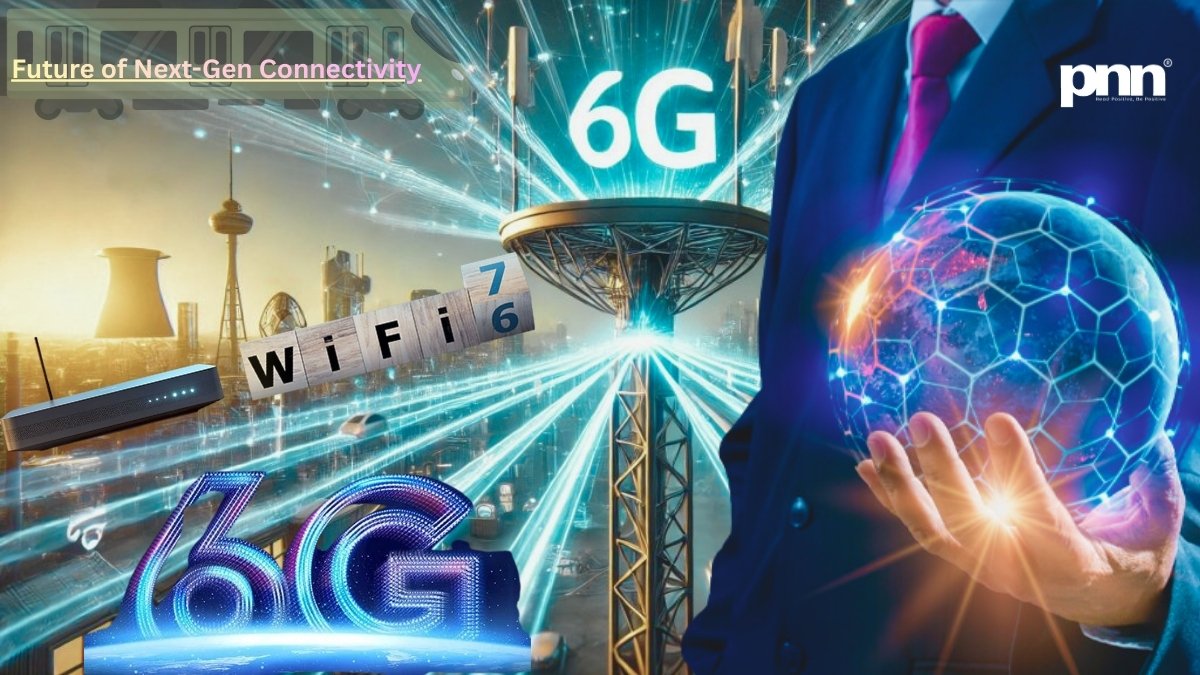
Bengaluru (Karnataka) [India], January 12: Next-gen connectivity is evolving into blueprint in a world where all gadgets, all cars, and all factory creatures are yelling at each other to become smarter and faster connected. A dynamic triumvirate is emerging, including 6G networks, Wi-Fi 7 wireless and edge computing architectures, as wireless standards move beyond 5G and Wi-Fi 6. They also offer not only quicker connections, but an altogether new language of how devices communicate, compute and cooperate; tomorrow, the digital aspect of life will be more immersive, intelligent, and reliable than ever.
Connectivity Beyond Speed
In the past, each generation of a wireless technology increased the data rate with every succession. Since mobile browsers via 3G enabled connecting to the Internet and 4G heralded the streaming revolution, 5G is changing the world with ultra-low latency to support IoT and AR/VR. Now, engineers and researchers are preparing the groundwork of the next jump 6G that is likely to come about in 2030. The networks will integrate intelligence into the infrastructure directly and a combination of communication and computing and sensing is going to be available.
In contrast to previous standards, which were designed with human users browsing or streaming as their primary use case, 6G is being developed as an Internet of Everything, where machines, sensors, and autonomous systems in the billions interact in real time. The adoption of AI in the network core will enable 6G networks to understand traffic dynamically, reduce congestion, and context-aware applications, as 6G networks will be able to reason and think alongside the applications they are providing.
Wi-Fi 7 A Step Change in Local Networks
As mobile standards are keeping pace, so is a significant upgrade to wireless local area networks (WLAN). Wi-Fi 7 (IEEE 802.11be) adds improvements to the achievements of Wi-Fi 6 and 6E, but these improvements are not in performance on paper, but in capacity to fulfill the most real-life functions.
Wi-Fi 7 focuses on efficiency, reliability, and multi-link functionality – the ability of devices to connect with each other using multiple frequency bands at once – rather than showing theoretical maxs. This represents a less frictional operation in densely populated areas such as office floors, civic areas, and smart houses full of devices.
These enhancements are not only speed-related. Wi-Fi 7 will reduce latency and increase connection stability when using high loads, which modern applications, such as cloud gaming, real-time collaboration tools, and AR/VR experiences, specifically need: more intelligent scheduling and better spectrum use.
Edge computing: Moving the Cloud Closer
At the base of connectivity and computation, we have another significant trend, which is edge computing. Rather than sending all the bits of data to remote cloud servers to be processed, edge architectures bring the computing resources nearer to devices, perhaps in base stations, local data centres, or even the devices.
This change is important in applications that have no tolerance for delay. Consider self-driving cars communicating sensor data within the span of microseconds, or a self-driving robot controlling a factory production line remotely. Managing decisions on the edge can reduce latency and bandwidth usage by several orders of magnitude and increase responsiveness, which is ideal in combination with the ultra-fast, ultra-intelligent networks of the future.
Connectivity That Thinks
Next-gen connectivity technologies are changing the nature of the operation of networks together. The upcoming standards such as 6G will be directly integrated with AI in the radio access network (RAN) – intelligent resource allocation, proactive maintenance, and intelligent routing. Networks will not respond to congestion or interference, but they will anticipate them.
This is not in the abstract: in industry, alliances are already propelling the research on AI-enhanced networking, linking telecommunications infrastructure with more powerful platforms of computation capable of processing even more complex data streams.
On the domestic and business front, on the other hand, Wi-Fi 7 is becoming popular with vendors launching advanced chipsets that enable synchronised transmissions, spatial reuse and low-latency routing. These are not enhancement activities, but they are a jump to the point of connection quality, where consistency is a key factor compared to speed.
Impact in the World: The Intersection of Connectedness and Everyday Life.
The effects of such an evolution are much more than speedy downloads:
The Smart Cities will employ hyper-connected sensors and real-time analytics to streamline traffic, energy and community services.
With low-latency control loops and predictive diagnostics, industrial IoT will be more profitable in terms of uptime and safety.
Entertainment and Collaboration technologies – holo-conferencing to cloud gaming will cease to be experienced as a service but as part of reality.
Remote surgery or intelligent telehealth Systems will operate on networks where a thousandth of a second can make a difference.
A Steady Road to Deployment
Although Wi-Fi 7 devices are now coming to the market, and edge computing is deploying at a faster pace, 6G remains several years away, where commercialisation is concerned, forecasted to happen between 2028 and 2030. However, the roadmap is already being developed by research, partnership, and early prototype networks.
It is a gradual transformation of the existing wireless generations to smart, edge-enabled ecosystems, which is based on a general industry agreement: speed is no longer the main reason behind connectivity, but smartness, reliability, and seamless experience.
The conclusion is a connecting point, which is to find a way of connecting the Future.
What used to be science fiction, network learning, computing on the fly, and adapting, is soon to be a reality of tomorrow. With the core of digital transformation being next-gen connectivity, organisations and consumers will all gain through a more responsive, smarter and integrated wireless world.
It might be an AI-driven 6G system, an ultra-fast Wi-Fi 7 installation, or an architecture of distributed edge computing, but the future of connectivity will be much more than high speed; it will be contextual, commensurate, and transformative.
If you object to the content of this press release, please notify us at pr.error.rectification@gmail.com. We will respond and rectify the situation within 24 hours.