






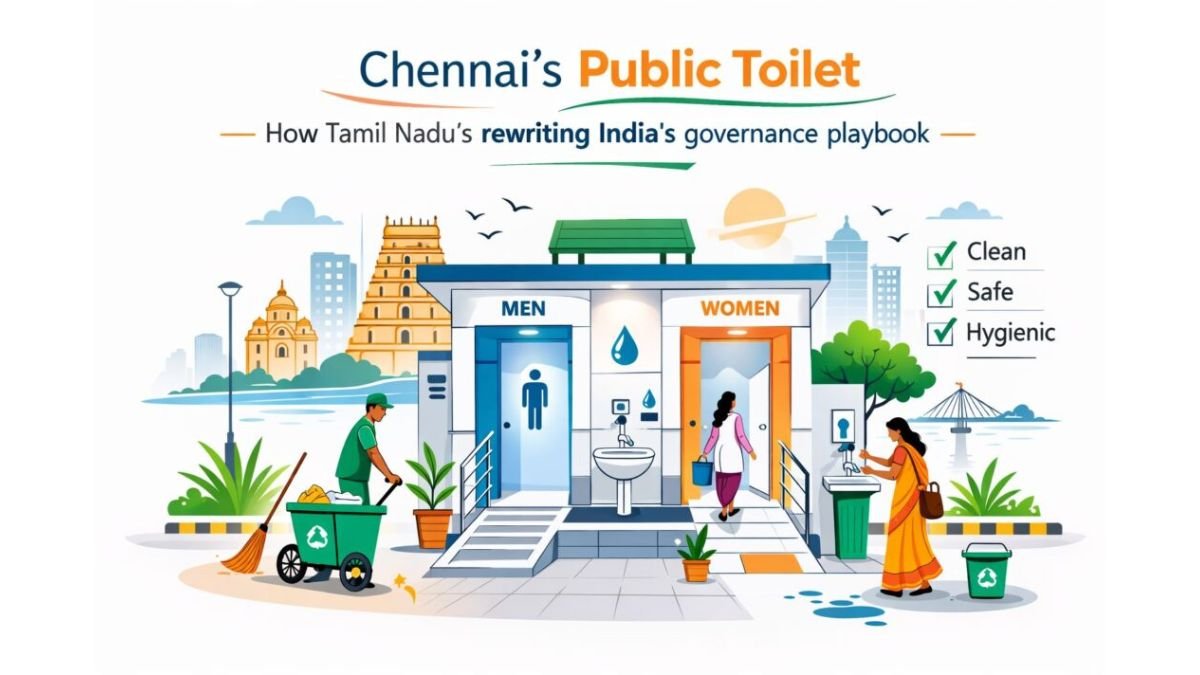
Chennai (Tamil Nadu) [India], February 21: Transformative governance does not always arrive draped in steel and glass. It does not depend on megaprojects slicing through skylines or ceremonial inaugurations broadcast in prime time. Often, it begins at street level — at a crowded bus terminus in Ambattur, along Pondy Bazaar artery in Theagaraya Nagar, beside a railway platform in Anna Nagar. In Tamil Nadu’s capital, a quiet but profound reordering of civic priorities is underway. The expansion of Chennai’s Public Convenience Toilet network is not merely a sanitation upgrade; it is a declaration of administrative seriousness — and a benchmark for the rest of India.
At its most immediate layer, sanitation is public health policy in concrete form. In dense urban corridors, disease transmission rarely explodes dramatically; it accumulates invisibly. Unmanaged wastewater, contaminated touchpoints, open urination in high-footfall zones, and deteriorating facilities generate a persistent microbial backdrop. Chennai’s insistence on clean, consistently serviced public toilets interrupts that chain of exposure. Each functioning unit operates as a decentralised health safeguard embedded within the city’s urban grid.
The dividends of such interventions are incremental but compounding. In a metropolis of millions, marginal reductions in infection rates translate into measurable declines in healthcare burden. Fewer gastrointestinal illnesses mean fewer lost workdays. Reduced exposure lowers household medical spending. Pressure on primary care facilities eases. In this calculus, sanitation precedes treatment. It is infrastructure designed to prevent the need for additional infrastructure.
The Gendered Geography of Access
For women, sanitation is not a peripheral amenity. It is a structural determinant of mobility — and mobility determines opportunity.
For adolescent girls, the availability of clean, functional public toilets directly influences school attendance, particularly during menstruation. Inadequate facilities often translate into absenteeism and, in vulnerable contexts, higher dropout risk. Reliable sanitation stabilises educational continuity and strengthens long-term human capital formation.
For young working women, especially those navigating extended commutes across Chennai’s metropolitan region, predictable access defines how long they can remain economically active in public space. Nurses, sales professionals, factory workers, gig-economy riders, and informal vendors operate within demanding schedules. Without dependable facilities, hydration is restricted intentionally, health complications rise, and work hours are shortened. Functional sanitation extends productivity, reduces urinary and reproductive health risks, and enhances workforce participation.
For women in informal commerce, sanitation is directly tied to income stability. Market vendors and street traders cannot afford prolonged absences from their stalls. Accessible facilities reduce income disruption and protect daily earnings in dense commercial corridors.
For pregnant women, public sanitation intersects with maternal health. Clean, proximate facilities reduce infection risks and physical strain during long transit or waiting periods. In this sense, sanitation becomes embedded preventive healthcare.
For elderly women, who often face mobility challenges and incontinence-related concerns, public toilet availability determines whether participation in public life remains feasible. Access sustains independence and preserves dignity.
Across these stages, sanitation reshapes the functional radius of women’s lives. Public space becomes navigable rather than restrictive. Time becomes reclaimable rather than rationed. Autonomy becomes operational rather than symbolic.
Safety, Dignity, and Public Citizenship
Design quality, lighting, maintenance frequency, and inspection compliance influence more than hygiene metrics — they shape perceptions of safety. Well-maintained facilities reduce vulnerability in high-footfall areas and normalise women’s presence in public spaces.
A city that provides dependable sanitation does not merely install infrastructure; it signals that women’s participation in civic and economic life is anticipated, protected, and supported.
Labour Dignity and Formalisation
Sanitation reform also recalibrates labour structures. Historically, public toilet maintenance in many Indian cities has relied on informal arrangements with minimal worker protections.
Chennai’s performance-linked model formalises this ecosystem. Roles are defined. Compensation is stabilised. Service standards are codified and audited. Cleanliness becomes an enforceable deliverable.
This transition is particularly consequential for women employed in sanitation services. Structured contracts reduce wage volatility and strengthen professionalisation in a sector long marginalised. The dignity embedded in this model extends both to users and to those responsible for sustaining service standards.
Institutional Architecture: Governance Beyond Construction
The Greater Chennai Corporation has anchored this initiative within a Design–Build–Finance–Operate–Transfer framework structured under the Hybrid Annuity Model. This marks a decisive shift from conventional public works contracting.
Under this arrangement, the concessionaire assumes responsibility not only for construction but for sustained operation and maintenance. Capital expenditure is partially disbursed during construction, while the remaining investment is recovered through annuity payments over the concession term. Crucially, those payments are tied to measurable performance benchmarks — uptime ratios, hygiene audits, inspection scores, and maintenance compliance. Completion alone does not trigger revenue. Performance does.
This lifecycle governance model represents institutional maturity. Infrastructure is no longer treated as an inauguration event; it is treated as a long-term service obligation.
Such structuring requires administrative rigor. Footfall analytics, ward-level inspection mechanisms, response logs, and compliance audits become governance instruments. Measurable performance limits ambiguity. Quantifiable deficiencies become actionable.
In steering this transformation, the Greater Chennai Corporation, under the guidance of its Special Projects Department, has played a foundational role. Embedding sanitation reform within a structured contractual and monitoring framework demands sustained oversight, technical supervision, and enforcement discipline. Translating policy design into operational continuity is an administrative achievement in itself.
Execution on Ground: Ferrgra
Within this broader architecture, execution capacity becomes decisive.
Ferrgra, the concessionaire for Package 3 — covering Zones 7, 8, 9 (excluding Marina), and 10 — carries responsibility for delivering consistent service quality across diverse and high-density urban zones.
Maintaining uptime, staffing facilities, ensuring cleanliness compliance, responding to inspection observations, and meeting contractual benchmarks require operational precision. In a performance-linked annuity structure, service delivery is not symbolic; it is audited and tied to financial flows.
The credibility of the governance model rests on sustained execution in such zones. When facilities function reliably in complex, high-footfall environments, institutional design is validated in practice.
The Essential Variable: Public Cooperation
Yet even the most robust contractual architecture cannot guarantee success in isolation.
Public sanitation networks are inherently shared assets. Their longevity depends on responsible usage, adherence to hygiene norms, avoidance of vandalism, and timely reporting of damage. Cleanliness is not sustained solely through audits and payments; it is reinforced through civic participation.
The long-term success of Package 3 across Zones 7, 8, 9 (excluding Marina), and 10 will depend on a threefold alignment:
- Administrative vigilance by the Greater Chennai Corporation
- Operational discipline by Ferrgra as concessionaire
- Active cooperation and shared ownership by citizens
When governance, execution, and public responsibility converge, sanitation infrastructure evolves from a facility into an institution.
From Sanitation to State Credibility
If sustained, the outcomes extend beyond hygiene metrics:
- Reduced disease incidence
- Expanded economic participation for women across life stages
- Improved educational continuity for girls
- Strengthened maternal and elderly health safeguards
- Formalised livelihoods within sanitation services
- Enhanced institutional credibility
Public toilets have historically been among the most neglected civic assets in Indian cities. Ensuring durable quality over years — not months — demands vigilance, enforcement, and collective ownership.
In shifting the metric of success from construction to sustained service, Chennai is not merely upgrading toilets. It is recalibrating the relationship between citizen and state.
And in that recalibration — anchored by administrative stewardship, operational accountability, and public cooperation — Tamil Nadu positions itself not simply as a participant in India’s urban evolution, but as a pace-setter.
Trust is not built in megaprojects alone.
It is built in the reliable delivery of the everyday.
In that quiet discipline, Chennai is setting the standard.
If you object to the content of this press release, please notify us at pr.error.rectification@gmail.com. We will respond and rectify the situation within 24 hours.