





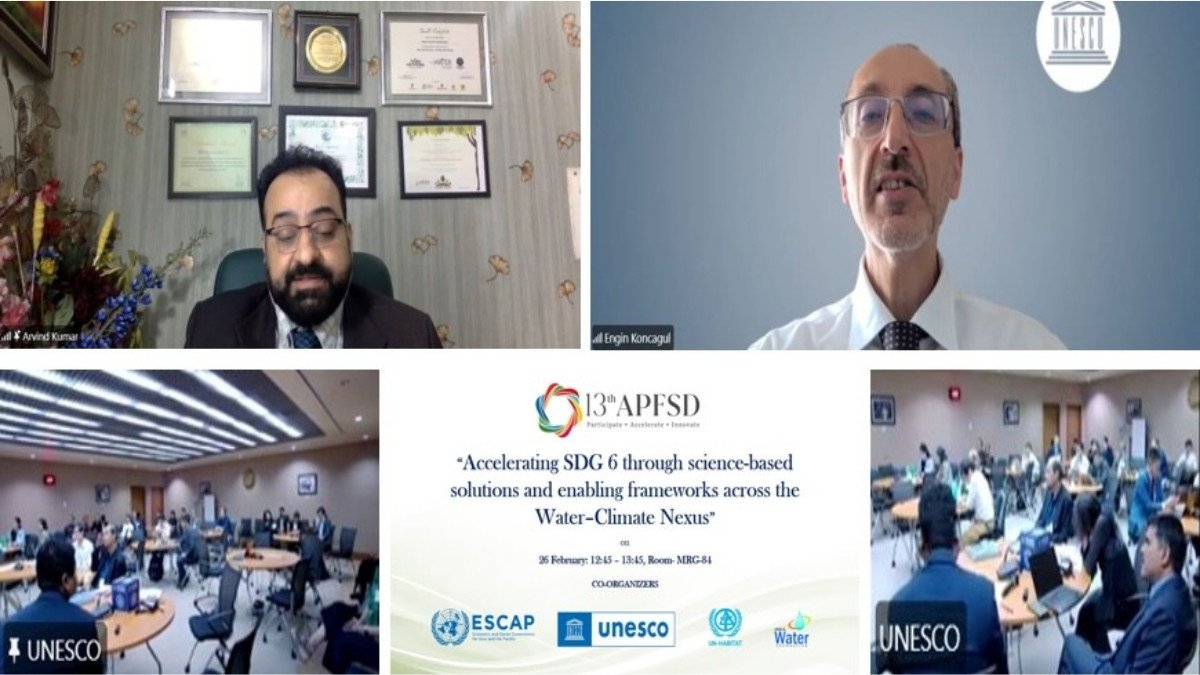
New Delhi [India], February 28: In a strong call for integrated and scalable action on water security, the India Water Foundation, United Nations Economic and Social Commission for Asia and the Pacific (UNESCAP), UN-Habitat, and UNESCO, successfully convened a high-level side event titled “Accelerating SDG 6 through science-based solutions and enabling frameworks across the Water–Climate Nexus” during the 13th Asia-Pacific Forum on Sustainable Development (APFSD).
Held in hybrid mode from 12:45–13:45 hrs, the session brought together global experts, policymakers, and development practitioners to address the urgent need to move from fragmented pilot initiatives toward systemic, scalable solutions for achieving Sustainable Development Goal 6 (Clean Water and Sanitation) across the Asia-Pacific region. Delivering a key intervention, Dr. Arvind Kumar, President, India Water Foundation, stressed that the core challenge is no longer the lack of ideas but the failure to scale proven solutions.
He emphasized three decisive levers: Integrated water–climate–urban–ecosystem frameworks; Innovative and blended finance mechanisms; Operational multi-stakeholder partnerships. Drawing on India’s experience, Dr. Kumar noted that embedding basin-level planning, ecosystem solutions, and demand management can significantly reduce climate risks across agriculture, cities, and natural systems. He also highlighted the massive climate finance gap in developing Asia, calling for blended finance, green-blue bonds, and outcome-linked public-private partnerships to make water projects bankable.
Opening the session, Mr Engin Koncagul, Senior Programme Specialist. UNESCO underscored that the region faces intensifying climate pressures, ecosystem degradation, and widening financing gaps, emphasizing that progress now depends less on isolated interventions and more on linking science, policy, and finance into coherent action frameworks. Ms Mikiko Tanaka, Director & Head, SSWA Office, UN ESCAP (Moderator) highlighted sobering regional trends. Experts like Mr. Tarik Hassan, Regional Coordinator, – Groundwater Cooperation and Climate Resilience UNESCO Regional Office, Bangkok; Mr Anshuman Varma, Economic Affairs Officer, Environment and Development Policy Section; Mr Avi Sarkar, Head, Lao PDR Regional Advisor, South-East Asia, UN-Habitat; Prof. Li Yalong, Director, Changjiang Water Resources Commission; Mr Rongkun Liu, Water Policy Specialist, ICIMOD, Presentations noted that the Asia-Pacific region is lagging on most SDG 6 targets, with severe ecosystem degradation including the loss or deterioration of nearly 80% of inland wetlands and 70% of mangroves. Rapid groundwater depletion, fragmented governance, and limited data sharing were identified as major structural barriers.
They stressed the growing importance of nature-based solutions such as wetland restoration, sponge cities, and blue carbon ecosystems in strengthening water security, regulating flows, improving water quality, and buffering climate risks. Case studies from Southeast Asia demonstrated how community-centred wetland restoration and climate-resilient urban planning can deliver multiple benefits for livelihoods, biodiversity, and disaster risk reduction. UN-Habitat highlighted the importance of institutional capacity, GIS-based planning, and inclusive local participation especially gender-responsive approaches for successful scaling.
The session converged on a clear message: achieving SDG 6 in the Asia-Pacific requires policy coherence, data harmonization, sustainable finance, and cross-border cooperation, particularly for groundwater and shared river basins. Participants underscored the need for: Stronger River basin institutions and data-sharing protocols; Integrated early warning systems; Nature-based infrastructure at scale; Regional observatories and open data platforms; Whole-of-government and whole-of-society partnerships
The side event concluded with a shared commitment to translate global frameworks into actionable national and city-level pathways, ensuring that water remains central to climate resilience, inclusive development, and ecosystem health. The India Water Foundation reaffirmed its role as a convenor and knowledge bridge across the water–energy–environment nexus and called for deeper regional collaboration to accelerate progress toward SDG 6 by 2030.