



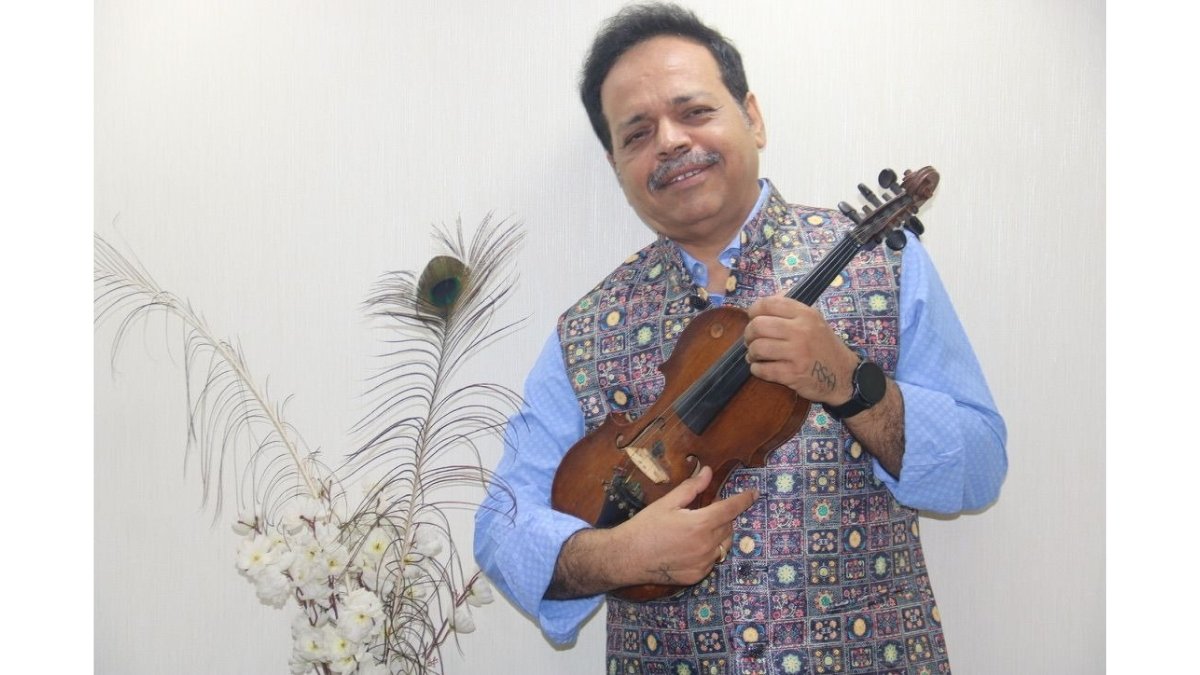
Author – Dr. Ratish Tagde, an accomplished violinist and President of Centre for Research & Promotion of Indian Music (CRPIM), Musicians Federation of India (MFI), Doctorate from Switzerland on music streaming revenues, a thought leader, and an Institution builder.
Mumbai (Maharashtra) [India], April 27: Artificial Intelligence has rapidly entered the world of music, with tools now capable of composing melodies, generating vocals, and even mimicking styles. Platforms like OpenAI and Google DeepMind are pushing the boundaries of what machines can create. This raises an important and urgent question for Indian Classical Music: Do these AI systems actually have authentic Indian classical music datasets? And if not, what risks does this pose?
The answer, as of today, is nuanced but concerning.
The Reality: Limited and Unstructured Presence of Indian Classical Music
Most AI music tools are trained on large-scale datasets sourced from the internet—streaming platforms, publicly available recordings, and licensed libraries. While Indian Classical Music does exist within this digital universe, it is neither adequately represented nor properly structured.
Unlike Western music, which often follows standardized notation and shorter compositions, Indian Classical Music is deeply improvisational, long-form, and context-driven. A raga is not just a sequence of notes; it is a framework governed by rules of ascent-descent, characteristic phrases (pakad), ornamentation, time theory, and emotional intent.
Current AI systems do not inherently understand these nuances. At best, they recognize surface-level patterns—scales, tonal clusters, or recurring phrases. What they often miss is the grammar that gives a raga its identity.
In simple terms, AI today may “sound like” Indian Classical Music, but it does not “understand” it.
The Dataset Problem: Quantity vs Quality
The challenge is not just about the availability of data, but about its quality, labeling, and structure.
For AI to learn meaningfully, datasets must be:
- Curated by experts
- Properly tagged (raga, taal, tempo, time of performance, gharana nuances)
- Clean in terms of audio quality (minimal noise, clear separation of elements)
- Representative of authentic styles
Most of the Indian Classical Music available online does not meet these criteria. Recordings are often mixed with audience noise, tabla bleed, or poor metadata. Even when high-quality recordings exist, they are rarely organized in a way that AI can interpret correctly.
As a result, AI models may learn distorted or incomplete versions of ragas.
The Core Risk: Distortion of a Living Tradition
If this situation continues, Indian Classical Music faces a serious risk—not of disappearance, but of distortion.
AI systems scale knowledge rapidly. Once a flawed understanding is embedded, it can spread across platforms, applications, and audiences at an unprecedented pace. A listener encountering Indian Classical Music through AI-generated outputs may unknowingly absorb an incorrect version of the tradition.
Over time, this can lead to:
- Simplification of ragas into mere scales
- Loss of improvisational depth
- Erosion of stylistic diversity across gharanas
- Misinterpretation of time theory and emotional context
The danger is subtle but profound. Indian Classical Music may continue to exist, but in a diluted, misrepresented form.
The First-Mover Problem: Who Defines the Dataset?
AI has a critical characteristic: the first high-quality dataset often becomes the reference standard.
If Indian classical musicians and institutions do not take the lead in creating structured datasets, others—technology companies, independent developers, or global platforms—will define them. These entities may have technological expertise, but not necessarily the cultural and musical depth required.
This creates a scenario where the custodians of the tradition lose control over how it is interpreted in the digital world.
Ownership and Ethical Concerns
Another significant risk lies in ownership and rights. If AI systems are trained on publicly available recordings of artists without clear consent or licensing, questions arise:
- Are artists being compensated for their contribution to AI learning?
- Who owns AI-generated music derived from their style?
- Can a machine replicate an artist’s voice or improvisational approach without permission?
Global discussions, including regulatory efforts like the EU AI Act, are beginning to address these concerns. However, the Indian Classical Music ecosystem has yet to establish a clear framework.
Without proactive action, artists may find their art being used, replicated, and monetized without their knowledge.
The Opportunity Hidden Within the Risk
While the risks are real, they also point toward a powerful opportunity.
Indian Classical Music has something that most global music systems do not—a deeply structured yet flexible framework, refined over centuries. If this knowledge is translated into well-curated datasets, AI can become a tool for:
- Preservation of rare ragas and compositions
- Documentation of gharana-specific nuances
- Creation of intelligent learning systems
- Global dissemination of authentic Indian Classical Music
In other words, AI can either distort the tradition or digitally immortalize it—depending on who takes the lead.
The Way Forward: A Call for Collective Action
The solution does not lie in rejecting AI, but in engaging with it strategically.
Key steps for the ecosystem include:
- Building curated, high-quality datasets led by musicians and scholars
- Establishing clear licensing and royalty mechanisms for AI usage
- Collaborating with technology developers to ensure accurate representation
- Creating awareness among artists about AI’s implications
- Forming institutional frameworks to govern AI in music
Organizations, research bodies, and cultural leaders have a critical role to play in this transition.
Conclusion: A Defining Moment for Indian Classical Music
So, do current AI tools truly have an authentic Indian Classical Music dataset? The answer is largely no—not in the structured, nuanced form that the tradition demands.
This gap presents a significant risk. If left unaddressed, AI may shape a version of Indian Classical Music that is technically impressive but culturally shallow.
At the same time, this is a defining moment. For perhaps the first time in history, musicians have the opportunity to influence how their tradition is represented at a global, technological scale.
Indian Classical Music has survived through adaptability and depth. In the age of AI, survival alone is not enough. The goal must be accurate representation, rightful ownership, and conscious evolution.
The future will not wait. The question is: Will the custodians of Indian Classical Music step forward to define it—or allow it to be defined for them?