






Retinoblastoma in Children: Why Early Detection Matters More Than Most Parents Realise
New Delhi [India], April 30: Most parents never expect a family photo to raise a medical concern. But for some parents, that is exactly what happens. The camera flash catches something different, one eye glows red as it should, and the other shows a strange white or pale reflection. Easy to dismiss as a glitch. Easy to scroll past.
For many children, that white glow in the eye is the first visible sign that something is wrong inside the eye.
Retinoblastoma is not a condition most people grow up knowing about. It is rare. But it is the most common eye cancer seen in young children, and the families who have been through it will tell you the same thing: they wish they had known sooner. Because the earlier it is caught, the more options a family has, and the better the chances of saving both the child’s vision and their life.
ASG Eye Hospital has made it a priority to change that. Not just by treating the condition, but by making sure more parents, more doctors, and more communities know what retinoblastoma is and how to identify it before it becomes serious.
Understanding Retinoblastoma and Who It Affects
Retinoblastoma starts in the retina, the thin layer at the back of the eye that processes light and sends signals to the brain. In young children, certain cells in the retina can begin dividing uncontrollably, forming a tumour. It sounds complicated, but the biology matters less than this simple fact: it grows fast, and it responds well to treatment when it has not spread far.
Retinoblastoma almost always affects children under five. Some cases run in families, passed down through a gene mutation. In those situations, both eyes can be affected, and siblings or future children may carry the same risk.
A parent with a family history of retinoblastoma should not wait for symptoms. Screening can begin at birth.
One of the most common questions doctors hear is whether retinoblastoma can be cured. In many cases, yes, particularly when it is found while still confined to the eye.
Early Signs of Retinoblastoma That Parents Should Know
Children rarely complain about their vision changing. They do not know what they are supposed to see. So the early signs of retinoblastoma tend to be spotted by someone watching, a parent, a grandparent, a nursery teacher, or a paediatrician doing a routine check.
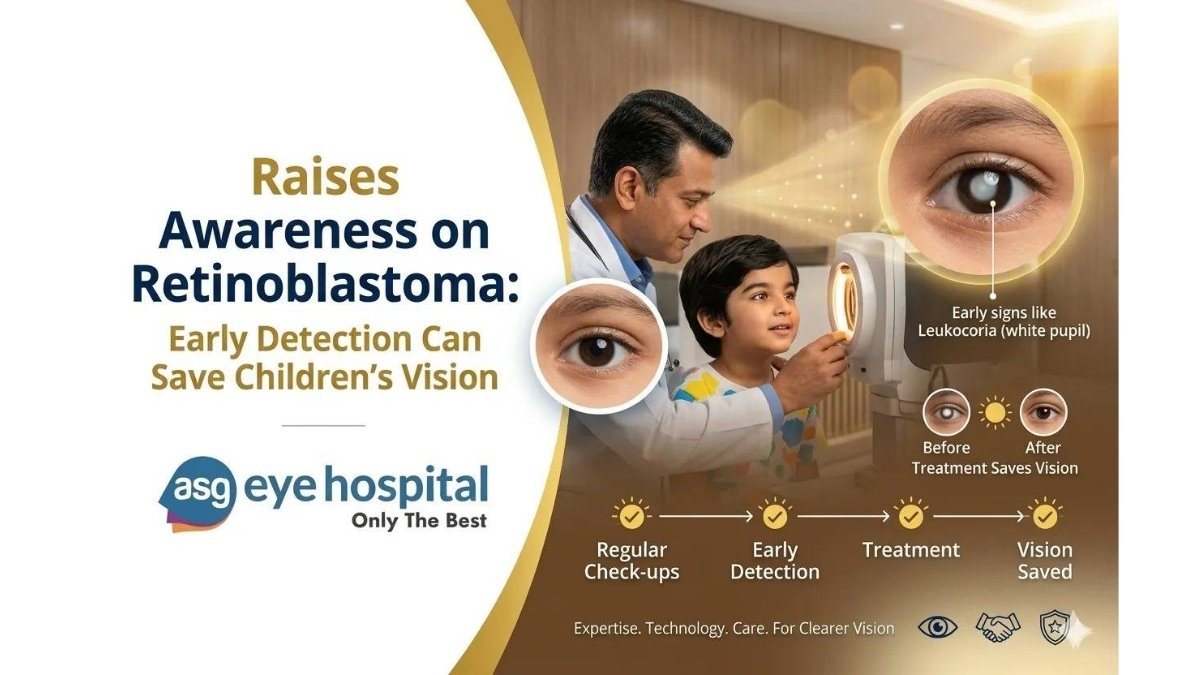
The sign that gets noticed most often is a white or yellowish glow in the pupil. In medical terms, it is called leukocoria. In everyday life, it shows up most clearly in flash photographs, where one eye catches the light differently from the other. In person, under normal lighting, it can be almost invisible, which is why so many families recall noticing it first in a photo rather than face-to-face.
Beyond that, other changes that may point to a problem include:
- One eye turning inward or outward, or appearing misaligned
- Persistent redness or visible swelling around the eye
- A shift in the colour of the iris
- A child rubbing or closing one eye more than usual
- Older children mentioning they cannot see properly from one side
One important thing to understand: retinoblastoma does not usually hurt. A child can have a growing tumour and show no signs of discomfort at all. That silence is part of what makes it easy to miss.
Eye Cancer in Children: Symptoms | What to Look for in Photographs
It might sound like an overstatement, but a mobile phone camera has genuinely helped catch retinoblastoma in children before a doctor ever got the chance to look.
Eye cancer in children often shows up in photographs long before they become obvious in daily life. The white reflex in child’s eye, leukocoria, happens because the tumour reflects light back through the pupil in a way healthy retinal tissue does not. With flash photography, that reflection can be quite stark.
Families describe noticing it at birthday parties, in holiday videos, in a random selfie taken on a Sunday afternoon. Some noticed it across several photos spanning months and convinced themselves it was just the camera angle.
If one eye consistently shows a pale or white reflection in flash photos, while the other shows the usual red-eye, that is worth taking seriously. It does not mean something is definitely wrong. But it does mean a specialist should take a look.
Pediatric Eye Cancer Diagnosis: How It Is Confirmed
When a child is brought in with a suspected eye problem, the examination needs to be thorough and with very young children, that usually means doing it under general anaesthesia. A toddler cannot be asked to stay still and look in a particular direction for the time it takes to properly examine the retina.
The ophthalmologist uses a specialised indirect ophthalmoscope to view the back of the eye in detail. If a tumour is present, its location, size, and spread are assessed. Ultrasound imaging can help map the extent of what is inside the eye. An MRI is used to check whether anything has spread beyond it.
A concern that comes up almost every time is whether the child will lose the eye. Understandably so. But the honest answer is that it depends almost entirely on when the diagnosis happens. Caught early, the eye can very often be saved. Caught late, the priority shifts to saving the child’s life.
At ASG Eye Hospital, paediatric eye examinations are carried out in a setting designed with young patients in mind, because a child who is calm and comfortable makes for a far more accurate assessment.
Retinoblastoma Treatment in India: What the Process Involves
Retinoblastoma treatment in India has come a long way. Families in cities across the country now have access to approaches that, not long ago, were only available at a handful of specialised centres abroad.
Treatment is never one-size-fits-all. It is built around how far the tumour has progressed, whether one eye or both are involved, and what is most likely to preserve vision while eliminating the cancer. The options commonly used include:
- Chemotherapy – given either through a vein or directly into the artery supplying the eye, to shrink the tumour before other treatments are applied
- Laser therapy or cryotherapy – used to target and destroy smaller tumours with precision
- Radiation therapy – considered in specific cases where other approaches are not sufficient
- Surgical removal of the eye – only when the tumour is at an advanced stage, and saving the eye is no longer a safe option
These treatments rarely happen in isolation. An oncologist, a paediatric ophthalmologist, and sometimes a radiation specialist work together to build a plan specific to each child.
Parents often want to know what vision will look like after treatment. Where the eye is preserved, and the response to treatment is good, useful vision is often maintained. But it is not guaranteed, and it depends heavily on where in the retina the tumour was sitting.
The Role of Routine Eye Checks in Children
A red reflex test takes about ten seconds. A paediatrician shines a light into a child’s eyes during a routine visit and checks that the reflection looks the same in both. If one eye shows a white or dull reflex instead of the expected red, that child gets referred to a specialist.
That one check, done at every well-child visit, is one of the most reliable ways to catch retinoblastoma early.
For children born into families with a known history of the condition, the process goes further. Genetic counselling, testing, and regular eye examinations under anaesthesia may begin from the first weeks of life.
ASG Eye Hospital actively supports retinoblastoma awareness among paediatricians and general practitioners, because a lot of retinoblastoma cases are first seen not in an eye clinic, but in a general practitioner’s consulting room. The sooner that referral happens, the better the outcome tends to be.
Why Early Detection Changes Everything
The gap between an early diagnosis and a late one can mean the difference between a child keeping their eye and losing it. In some cases, it is the difference between a localised tumour and one that has spread beyond the eye entirely.
Children whose retinoblastoma is diagnosed while still small and contained have the strongest outcomes, both for survival and for sight. Those who reach a specialist after months of unnoticed progression face harder choices and fewer options.
There is no sophisticated test required to start that process. It begins with a parent knowing what a white reflex in child eye looks like in a photograph. It begins with a General Practitioner who refers rather than waits. It begins with communities talking openly about retinoblastoma, because it is rare and tends to stay in the shadows.
ASG Eye Hospital, with centres across Jodhpur, Mumbai, Delhi, Jaipur, Pune, Guwahati, and more, is working to make sure that retinoblastoma awareness reaches every corner of the country, because every child deserves to be seen clearly and seen in time.
FAQs
1. What Are the Most Common Retinoblastoma Symptoms in Children?
The most frequently noticed sign is a white or pale glow in one eye, particularly visible in flash photographs. A squint, persistent redness, or a change in eye colour can also be early indicators worth checking out.
2. What Causes the White Reflex in a Child’s Eye?
The tumour sits inside the retina and reflects light through the pupil. Instead of the normal red reflex seen in photos, the affected eye shows white or yellow, a sign that something is different at the back of the eye.
3. At What Age Does Retinoblastoma Usually Develop?
The majority of cases are diagnosed in children under five. It becomes significantly less common as children get older and is rarely seen in adults.
4. Is Retinoblastoma Treatable in India?
Yes. Access to specialised paediatric eye cancer diagnosis and treatment has improved considerably across India. When found early, outcomes are genuinely encouraging.
5. Should All Children Be Screened for Retinoblastoma?
A basic red reflex check at routine paediatric visits is something every child should have. For those with a family history of the condition, more thorough and frequent screening from birth is strongly recommended.
If you object to the content of this press release, please notify us at pr.error.rectification@gmail.com. We will respond and rectify the situation within 24 hours.