
A Reflection Ahead of the NMACC Symposium on Music Copyrights & AI
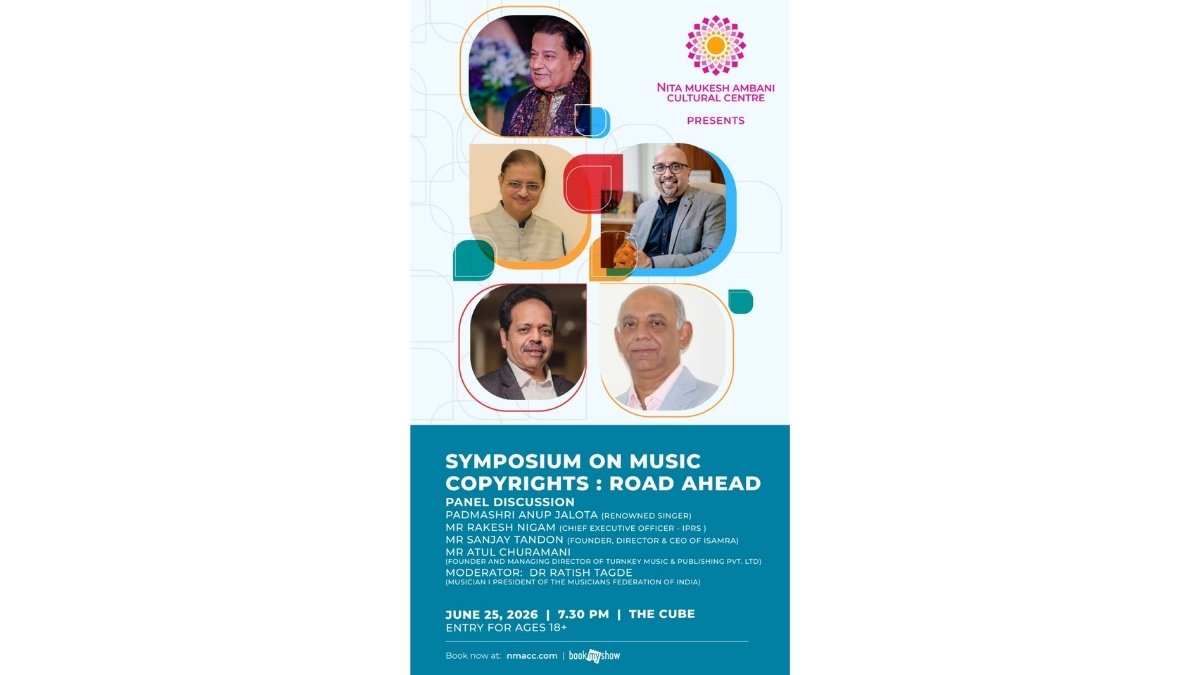
New Delhi [India], June 02: On June 25, 2026, some of the most respected voices from India’s music and copyright ecosystem will come together at the Nita Mukesh Ambani Cultural Centre (NMACC), Cube Theatre, Mumbai, for an important conversation on the future of music rights, technology, and artificial intelligence.
The symposium will feature Padma Shri Anup Jalota, Rakesh Nigam, Sanjay Tandon, and Atul Churamani, with the discussion moderated by Dr. Ratish Tagde.
At a time when artificial intelligence is transforming the global music industry, this symposium aims to address a critical question: Can copyright laws evolve fast enough to protect human creativity in the age of AI?
Importantly, this initiative by Nita Mukesh Ambani Cultural Centre deserves appreciation for bringing together artists, copyright institutions, industry leaders, and thinkers on a platform dedicated not merely to entertainment, but to meaningful cultural dialogue. In an era where technology is reshaping the creative ecosystem at unprecedented speed, such forums are essential for the future of India’s music and artistic heritage.
The Foundation of the Music Economy
Music is not merely art; it is also intellectual property. Every composition, lyric, recording, performance, and broadcast creates economic value. Copyright law exists to ensure that creators are recognized, protected, and fairly compensated for their contribution.
India’s Copyright Act has evolved significantly over the decades, especially after the landmark 2012 amendments, which strengthened the rights of authors, composers, singers, and performers. These changes brought greater clarity to royalty sharing, performer rights, and the role of collective management organizations.
Organizations such as Indian Performing Right Society (IPRS) and Indian Singers and Musicians Rights Association (ISAMRA) have played an important role in creating awareness, collecting royalties, and protecting creators in a rapidly changing digital landscape.
For years, the music industry’s copyright debate revolved around radio, television, physical formats, piracy, streaming platforms, and digital licensing. However, the AI era has introduced an entirely new dimension to this conversation.
AI: The Biggest Disruption Yet
Artificial intelligence is no longer a futuristic concept. AI music systems can now generate melodies, create synthetic vocals, imitate musical styles, and compose background scores within seconds.
This technological leap creates both excitement and anxiety.
On one hand, AI can democratize music production, enhance accessibility, and create new opportunities for creators. On the other hand, it raises serious concerns regarding ownership, consent, attribution, and authenticity.
If an AI system is trained on thousands of songs composed by human musicians, should those musicians receive compensation?
If a machine replicates the voice or stylistic identity of an artist, where does artistic originality stand?
If AI-generated music floods digital platforms, how will audiences differentiate between authentic cultural traditions and synthetic approximations?
These are not hypothetical questions anymore. They are becoming central to the future of the global music economy.
The Indian Classical Music Concern
The debate becomes even more sensitive in the context of Indian Classical Music.
Indian Classical Music is not built merely on fixed compositions. It is deeply rooted in improvisation, emotional intelligence, gharana traditions, raga grammar, and decades of spiritual and artistic training.
An AI system may reproduce notes, but can it truly understand the emotional maturity of a vilambit khayal, the meditative depth of a dhrupad alap, or the spontaneity of a live raga improvisation?
The concern is not just about imitation. The larger issue is the absence of properly structured and authenticated Indian Classical Music datasets within the AI ecosystem.
If global AI systems begin generating “Indian classical music” based on incomplete or inaccurate datasets, the next generation of listeners may unknowingly consume distorted versions of the tradition. Over time, this could alter public perception of what authentic Indian classical music actually is.
This is where copyright, preservation, and AI governance intersect.
Beyond Protection: The Need for Structured Participation
The road ahead cannot simply be about resisting technology. History has shown that music evolves with every technological transition — from darbars to gramophone records, from radio to streaming platforms, and now from streaming to AI-driven ecosystems.
The challenge is to ensure that creators are not excluded from this transition.
The future may require new licensing frameworks specifically designed for AI training datasets. Musicians may need rights over how their content is ingested, analyzed, replicated, or commercially deployed by AI systems. There could also emerge a need for transparent AI audit trails, metadata standards, and revenue-sharing mechanisms connected to machine learning usage.
This conversation becomes even more relevant for traditional and classical musicians, whose art forms are culturally invaluable but commercially underrepresented in mainstream digital ecosystems.
The industry must begin discussing how artists can participate in AI infrastructure creation rather than becoming passive subjects of technological disruption.
A Timely Industry Dialogue
The upcoming symposium at NMACC is therefore more than just a panel discussion. It represents an important industry dialogue at a defining moment for music and culture.
With perspectives ranging from copyright enforcement and international legal frameworks to performer rights and artistic realities, the panel promises to address both the opportunities and the risks emerging from AI-driven creativity.
Padma Shri Anup Jalota brings the invaluable perspective of a legendary performing artist who has witnessed multiple eras of music consumption.
Rakesh Nigam represents the evolving framework of authors’ and composers’ rights in India.
Sanjay Tandon brings the viewpoint of singers and musicians navigating digital-era performer rights.
Atul Churamani contributes a global perspective on copyright systems and international developments in AI-related music law.
And Dr. Ratish Tagde, as moderator, will steer the discussion toward the larger ecosystem question: How can India protect the authenticity, sustainability, and future relevance of its music traditions in the AI era?
The Road Ahead
The future of music will not be shaped only by technology companies or algorithms. It will also be shaped by policymakers, copyright institutions, artists, educators, cultural organizations, and informed audiences.
Artificial intelligence may become one of the most powerful tools ever created for music discovery and distribution. But unless ethical frameworks, copyright protections, and authentic datasets evolve alongside it, the creative ecosystem could face serious imbalance.
The coming years will therefore demand not just innovation, but stewardship.
The objective is not to stop technology, but to ensure that human creativity, cultural authenticity, and artistic dignity remain at the center of the musical journey ahead.