






New Delhi [India], June 26: In today’s highly competitive telecommunications industry, where market control is often concentrated in the hands of a few large corporations, Kerala Vision stands out as a remarkable alternative. It exemplifies a unique “Kerala Model” of business that empowers small-scale entrepreneurs through collective ownership and collaboration. By combining decentralized participation with the strength of collective bargaining, Kerala Vision has built a sustainable ecosystem that not only supports local operators but also competes effectively with major national and multinational players.
This evolution is best epitomized by the group’s achievement of the 1,160-crore turnover milestone, a feat made possible by the “Cooperate Corporate” philosophy. This hybrid organizational structure synthesizes the democratic, stakeholder-centric values of a cooperative with the professionalized operational efficiency of a modern corporation. While today it stands as a financial powerhouse with millions of subscribers, the genesis of this movement was not found in a pursuit of profit, but in a desperate, defensive struggle for industrial survival.
From COA to Corporate Identity
The strategic foundations of Kerala Vision were laid in 1996 with the formation of the Cable Operators Association (COA). This was a move of necessity; local operators faced an existential threat as large-scale corporations attempted to monopolize infrastructure by seizing control of the rights to string cables on electric poles. Combined with the predatory channel rates demanded by broadcasters, these policies threatened to disenfranchise thousands of independent entrepreneurs. The COA functioned as a collective bargaining unit, designed to mitigate this imbalance of power through organized resistance.
The catalyst for this movement was the “Wayanad Movement,” led by K. Govindan. What began as local defiance against infrastructure monopolies in the Wayanad district ignited a state-wide shift in the “Principal-Agent” dynamic. By 2002, the leadership recognized that mere protest was insufficient to combat the shifting technological landscape. The organization underwent a strategic transformation, pivoting from a “protest organization” into a formalized “entrepreneurial entity” with a robust constitution and a market-oriented objective.
This transition was guided by a distinct theoretical framework. As former Chairman K. Govindan articulates, the “Cooperate Corporate” model is a business structure where professional companies are run by the collective for the welfare of all stakeholders. This philosophical bedrock provided the legitimacy and organizational discipline required to formalize their operations into a competitive business structure.
The Architect of Growth of KCCL
In 2006, the movement achieved a critical milestone with the establishment of Kerala Communicators Cable Limited (KCCL). This was a dual-purpose maneuver: it served as a defensive shield to consolidate a fragmented market and an offensive strike to achieve the economies of scale necessary to compete with national Multi-System Operators (MSOs). The inaugural leadership featured Nazar Hassan Anwar (N.H. Anwar) as Chairman and K. Govindan as Managing Director.
The organization’s most potent strategic asset is its decentralized ownership structure, which utilizes a “disaggregation of equity” to prevent predatory acquisition.
The 1% Ownership Rule: Ownership is distributed among approximately 6,000 local operators. The internal governance culture strictly ensures that it is rare for any single individual or family to hold more than 1% of the total shares.
Hostile Takeover Shield: By ensuring no single entity can acquire a controlling interest, KCCL has created a structural immunity to hostile takeovers by larger corporate giants.
Stakeholder Alignment: This model virtually eliminates the classic agency problem, as the shareholders are the same local operators responsible for service delivery and customer retention.
This robust corporate architecture allowed KCCL to transition from a regional collective to a dominant force in the national television market.
Dominating the Airwaves: KCCL’s Market Milestones
KCCL’s ascent to becoming India’s 4th largest Multi-System Operator (MSO) is a testament to the efficacy of the “Cooperate Corporate” model. By maintaining a hyper-local presence while operating with national-level professional standards, KCCL has effectively turned its regional focus into a competitive moat. A pivotal moment in this journey was the 2012-13 digitization period, where the company outpaced larger rivals in infrastructure upgrades.
KCCL Market Impact
KCCL has established itself as a dominant force in Kerala’s cable television industry, serving up to 37 lakh TV connections across the state. Ranked as the 4th largest Multi-System Operator (MSO) in India, the company commands an impressive 65% market share in Kerala, reflecting its extensive reach and strong customer base. KCCL also demonstrated remarkable technological leadership during the 2012–13 digitization phase, rapidly adopting and deploying new equipment to ensure a smooth transition to digital broadcasting, setting a benchmark for the industry.
With a commanding 65% market share, KCCL has dictated the competitive landscape in Kerala, creating high switching costs for consumers and marginalizing multinational competitors. However, the leadership recognized that the commoditization of cable TV was inevitable, prompting a strategic pivot toward the burgeoning data revolution.
The Broadband Revolution: Kerala Vision Broadband Limited (KVBL)
In 2016, the group initiated a vertical integration strategy by forming Kerala Vision Broadband Limited (KVBL). This move allowed the organization to leverage its existing “last-mile” infrastructure to meet the surging demand for high-speed internet. Beyond market capture, KVBL has been instrumental in mitigating the “Digital Divide,” aggressively expanding into territories often ignored by urban-centric telecom giants.
KVBL Performance Metrics
Market Penetration: Over 12 lakh broadband connections.
National ISP Ranking: 6th out of approximately 1,500 active ISPs.
Rural Dominance: 2nd largest Rural Broadband Provider in India, trailing only the state-run BSNL.
This expansion demonstrated that a cooperative model could master the high capital expenditure and technical rigors of the ISP sector, provided it maintained its core strength: the local operator’s connection to the community.
The “Local” Advantage: Relationship-Based Service
The primary competitive differentiator that prevents multinational telecom giants from achieving dominance in Kerala is Kerala Vision’s “Hyper-local Service Delivery Model.” At the heart of this is “Proportional Revenue Sharing,” a system that ensures the majority of revenue is retained by the ground-level operator. This creates a vested interest that transforms 6,000+ operators into dedicated entrepreneurs rather than mere employees.
In contrast to the “faceless customer care” and bureaucratic friction of multinational corporations, Kerala Vision offers a “Relationship-based service.” Because the operator is a member of the local community, technical failures are addressed with a speed and personal accountability that automated systems cannot replicate. This trust-based model creates immense brand equity and customer loyalty.
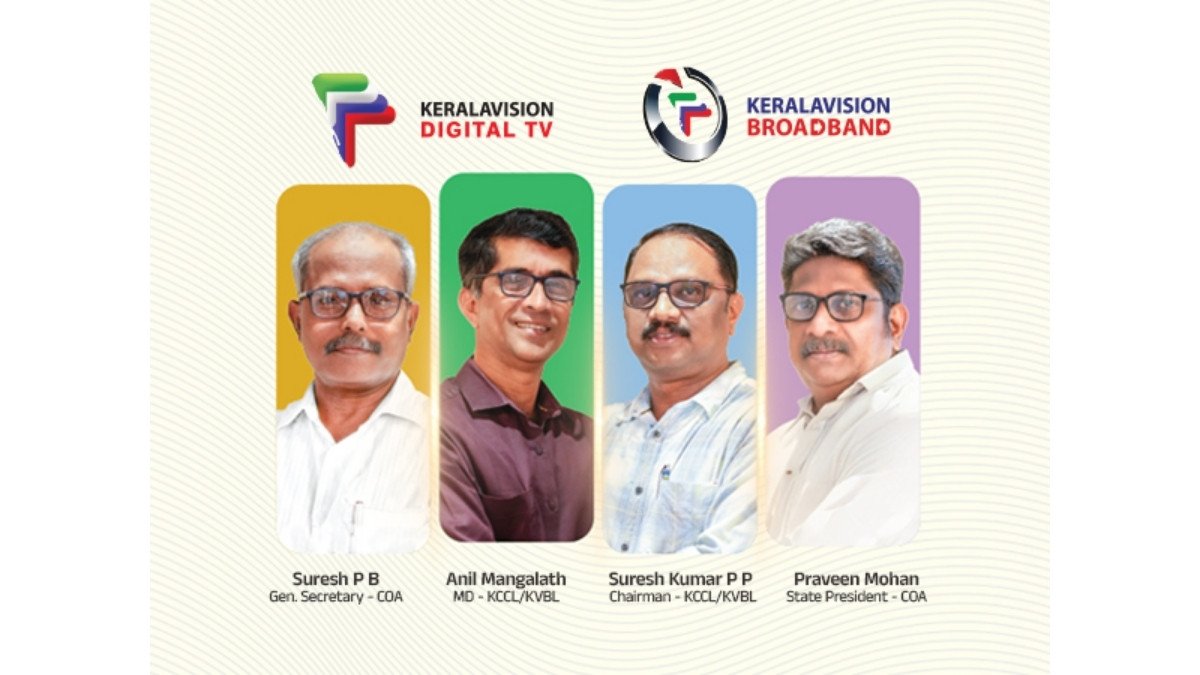
Managing Director Anil Mangalath notes that this local agility is balanced by global technical standards. To maintain this edge, the organization’s technical teams regularly attend national and international technical expos to facilitate R&D and ensure the rapid implementation of cutting-edge technology. This commitment to continuous learning ensures that the organization’s “local” service is backed by “global” expertise.
Future Horizons: Total Service Provider and Infrastructure
Kerala Vision is currently undergoing a strategic evolution to become a “Total Service Provider” (TSP). This move represents a “future-proofing” of the business model, shifting focus from individual residential connections to high-value digital transformation projects for malls, educational institutions, and corporate complexes.
New TSP Service Offerings (Vertical Integration):
- Advanced Electronic Security and Surveillance Systems
- Comprehensive Data Collection and Digital Security Solutions
- Integrated Building Control Systems
- IT-based Audio-Visual and Professional Call Center Services
Further cementing its role as a state infrastructure leader, Kerala Vision presented two flagship projects at the Global Investors Meet. The first is an ambitious underground Optical Fiber network extending from Kasaragod to Thiruvananthapuram, designed to provide a proprietary backbone for the state’s digital future. The second is a strategic diversification into the Tourism sector, demonstrating the company’s intent to leverage its organizational network for broader economic impact.
The Legacy of the Kerala Model
The trajectory of Kerala Vision provides an empirical refutation of the idea that small-scale operators cannot survive the digital age. It serves as a masterclass in how the “Cooperate Corporate” philosophy—combining unity, democratic ownership, and professional management—can level the playing field against monopoly power.
With a 1,160-crore turnover and a network spanning millions of households, Kerala Vision has transcended its origins as a protest movement to become the “digital backbone” of the state. Its legacy is a proven blueprint for stakeholder capitalism, demonstrating that when local entrepreneurs align their interests, they do not just compete in the market—they define its future.
If you object to the content of this press release, please notify us at pr.error.rectification@gmail.com. We will respond and rectify the situation within 24 hours.