





Mumbai (Maharashtra) [India], July 3: For decades, India’s journey to space had a familiar signature. The rockets were government-built, the missions were nationally celebrated, and every successful launch quietly reminded the world that innovation didn’t always require billion-dollar extravagance. Today, however, a different chapter is unfolding. The spotlight is slowly shifting from public institutions to ambitious private startups, where engineers, entrepreneurs, and investors are collectively rewriting India’s commercial space story.
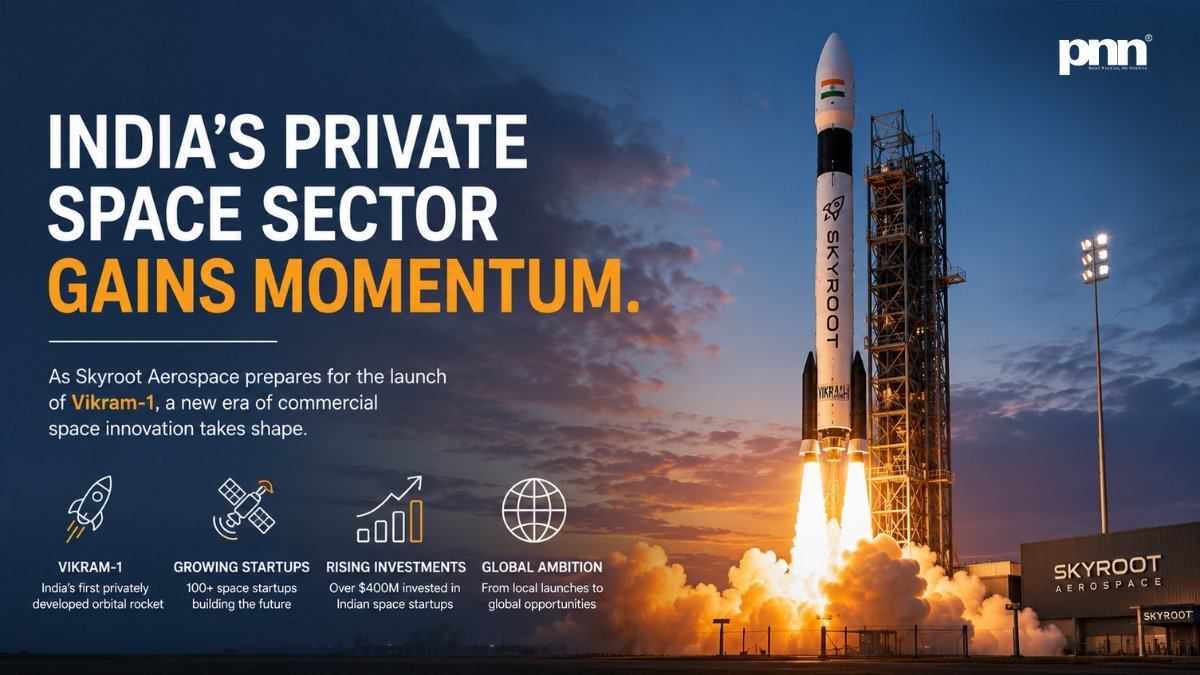
At the centre of this momentum is Skyroot Aerospace, which is preparing for the launch of Vikram-1, India’s first privately developed orbital rocket. Although the mission has yet to lift off, its significance extends far beyond one launch vehicle. It symbolises a broader transformation in India’s aerospace ecosystem, where private companies are increasingly moving from suppliers to full-fledged innovators.
The countdown, it seems, isn’t just for a rocket.
It’s for an entirely new industry.
A New Chapter Beyond ISRO
India’s achievements in this have long been associated with the Indian Space Research Organisation (ISRO). From the Mars Orbiter Mission (Mangalyaan) to the recent success of Chandrayaan-3, ISRO has built a global reputation for delivering ambitious missions at remarkably efficient costs.
Yet, the global space economy has changed dramatically.
Governments are no longer expected to do everything themselves. Around the world, commercial companies are designing rockets, manufacturing satellites, providing launch services and developing technologies that once belonged exclusively to national agencies.
India is now embracing that model.
Policy reforms introduced over the past few years—including the creation of IN-SPACe, which facilitates private-sector participation—have encouraged startups to build launch vehicles, satellite platforms, and advanced aerospace technologies.
The result is an ecosystem that barely existed a decade ago.
Apparently, reaching for the stars is no longer reserved for governments.
Why Vikram-1 Matters
Skyroot’s Vikram-1 represents more than another rocket waiting on a launch pad.
It represents confidence.
If successful, the mission would demonstrate that privately developed Indian launch vehicles are capable of placing satellites into orbit, opening new opportunities for commercial customers both domestically and internationally.
The rocket is designed to serve the growing small satellite market, one of the fastest-expanding segments within the global space economy. As satellite constellations continue supporting communications, navigation, Earth observation and climate monitoring, demand for reliable launch services is rising rapidly.
For Skyroot, the mission is technical.
For India’s private industry, it is symbolic.
Investment Is Following The Opportunity
Investor confidence in India’s ecosystem has grown significantly.
Industry estimates suggest that Indian space startups have collectively attracted well over $400 million in private funding in recent years, while government initiatives continue encouraging domestic manufacturing and technological innovation.
Companies are now emerging across multiple areas of the value chain, including:
- Launch vehicle development
- Satellite manufacturing
- Earth observation technologies
- Space data analytics
- Propulsion systems
- Communication infrastructure
Analysts estimate the global space economy could surpass $1 trillion by 2040, creating enormous opportunities for countries capable of building competitive commercial ecosystems.
India clearly wants a larger share of that future.
The Benefits Extend Beyond Rockets
The rise of private aerospace companies carries implications far beyond space exploration.
A stronger commercial ecosystem can generate high-skilled employment, attract foreign investment, and accelerate innovation across industries, including defence, telecommunications, agriculture, and disaster management.
Potential advantages include:
- Greater private investment in advanced technology.
- High-value engineering and manufacturing jobs.
- Improved satellite launch capabilities.
- Increased international commercial partnerships.
- Stronger global competitiveness for India’s technology sector.
The ripple effects may ultimately reach far beyond launch pads.
Every successful rocket carries hundreds of smaller industries along with it.
The Challenges Remain Grounded
Despite growing optimism, commerce remains one of the world’s most difficult businesses.
Rocket development demands enormous capital, years of testing and extremely high engineering standards. A single unsuccessful launch can delay programmes, affect investor confidence and significantly increase costs.
Private companies also face several practical hurdles:
- High research and development expenditure.
- Complex regulatory compliance.
- Intense global competition.
- Launch reliability expectations.
- Long profitability timelines.
Space, after all, has never rewarded shortcuts.
Gravity remains wonderfully unbiased.
The Bigger Picture
Perhaps the most remarkable aspect of India’s commercial space journey isn’t that startups are building rockets.
It’s that they’re changing the national conversation.
Not long ago, private participation in India’s sector seemed like a distant possibility. Today, entrepreneurs are discussing orbital launches, reusable technologies and global customers with growing confidence.
Whether Vikram-1 becomes a flawless success or simply another learning milestone, its importance extends beyond a single mission.
It represents an industry discovering its own identity.
The Final Countdown
India’s private space sector is no longer an experimental side project—it is steadily becoming an integral part of the country’s technological ambitions. Skyroot Aerospace’s upcoming Vikram-1 mission reflects years of policy reform, engineering talent and investor confidence converging toward a common objective: making India a significant player in the global commercial space economy.
The journey ahead remains demanding.
Rockets will fail.
Funding cycles will fluctuate.
Competition will intensify.
Yet history suggests that every mature space programme is built as much on perseverance as precision.
Perhaps India’s greatest launch isn’t Vikram-1 itself.
Perhaps it’s the confidence that the next generation of space pioneers no longer has to wait for permission to build the future.