

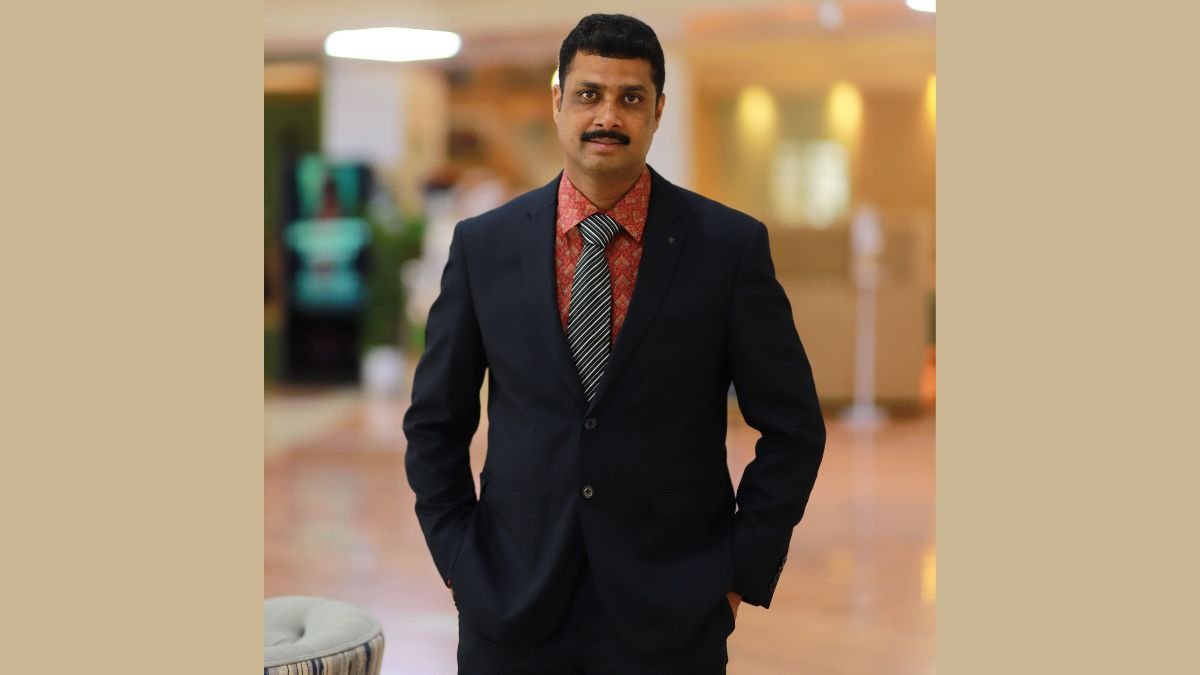
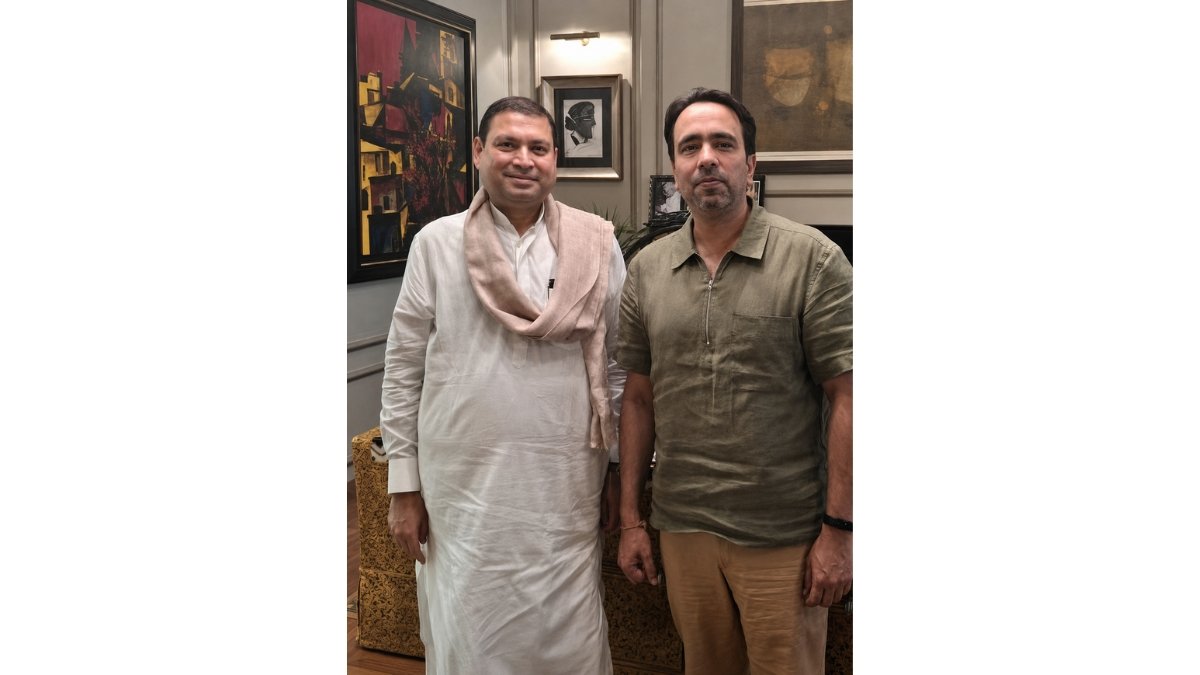
A file picture of Kolkata-based social and cultural activist Sundeep Bhutoria with Shri Jayant Chaudhary, Union Minister of State for Education.
Kolkata (West Bengal) [India], September 4: Imagine six-year-old children, barely out of kindergarten, bent forward under a bag weighing nearly a quarter of their own body weight. This isn’t a hypothetical scenario. It is a crisis in plain sight, a reality for millions of Indian schoolchildren — and a health concern that Kolkata-based social and cultural activist Sundeep Bhutoria has now thrust into the national spotlight.
This is not the first time Mr Bhutoria has pursued a matter of everyday hardship with a Union Ministry. In 2017, he first wrote to the then Minister of External Affairs, the late Sushma Swaraj, drawing attention to the health risks of requiring newborns and infants to appear in person at Passport Seva Kendras for biometric registration. He had pursued the matter relentlessly and after sustained follow-up the ministry finally changed the rules to exempt children below the age of five from appearing at the Kendras.
In a formal written appeal to the Union Minister of State for Education, Shri Jayant Chaudhary, Mr Bhutoria has called for a robust national push to implement the School Bag Policy, 2020. The policy, aligned with the National Education Policy (NEP) 2020, provides a clear and scientifically backed guideline: a child’s school bag should not exceed 10% of their body weight. Yet, despite this framework, stories of children struggling with back-breaking loads continue to dominate headlines.
“The goal is not to dilute academic standards but to ensure that better learning does not require a heavier physical burden. A lighter school bag would become a ‘visible expression’ of the Government’s larger vision for education — one focused on joyful, experiential learning and the holistic wellbeing of the child,” Mr Bhutoria said.
The appeal has quickly resonated with prominent voices. Mr Bhutoria, who is also the Managing Trustee of the NGO Prabha Khaitan Foundation, shared a copy of his letter to the Minister on his official X handle. It was subsequently re-shared and endorsed by renowned brand strategist Suhel Seth, while Grammy Award winner Ricky Kej also commented on it. Celebrated author and politician Shashi Tharoor reacted, saying, “Agree totally on this. Seeing little children groaning under the weight of their bags is deeply disturbing.”
“The framework is already in place,” Mr Bhutoria writes in his letter. “The challenge and the opportunity before us all is to ensure that it becomes a simple, uniform and measurable practice across schools in the country.”
The policy also rests on firm judicial ground. It was the Madras High Court, in M. Purushothaman v. Union of India (2018), that directed the Union Government to frame a national school bag policy — calling for its adoption by all States and Union Territories, the constitution of flying squads for inspection, and curbs on unnecessary books and homework. Two years later, in Johny Cyriac v. MHRD (2020), the Kerala High Court pressed for implementation “in letter and spirit” with periodic inspections, recognising excessive school burden as a child-rights concern under Articles 21 and 39(e) and (f) of the Constitution.
The problem is pervasive. A national survey conducted while framing the policy found that a staggering 77.7% of parents consider heavy school bags a “serious problem” for their children. This is not merely a matter of inconvenience; it carries significant health implications.
Medical experts warn that chronic strain from heavy bags can lead to permanent posture disorders, back pain, muscle strain, and spinal issues such as scoliosis.
A recent study in Bangalore revealed that students carried backpacks averaging 13.53% of their body weight, with a significant link found to postural issues and increased pain prevalence.
In Mangalore, another study found that an alarming 82.6% of children were carrying overloaded school bags.
The problem is especially acute for younger children. A viral image of a Class 1 student carrying a 4.5 kg bag — over 20% of his body weight — forced parents to confront this everyday reality.
Mr Bhutoria’s appeal highlights that solutions are already working in several States, proving that large-scale implementation is administratively possible. Maharashtra offers the earliest precedent: in a drive in 2016, officials inspected over 17,000 schools and checked nearly four lakh school bags, achieving an 87.45% compliance rate. West Bengal has more recently moved to operationalise the 10% limit, issuing charts that prescribe bag weights according to class and body weight, while the Bihar Education Department has directed all private and government-aided schools to adhere to NCERT guidelines, mandating regular weighing and warning of action for violations. In Assam, districts such as Kamrup Metro have enforced strict class-wise caps — 1.5 kg for Classes I and II, rising to 5 kg for Class X — to reduce the burden on students.
Drawing on these successful models, Mr Bhutoria has suggested a simple, non-bureaucratic pathway for a national rollout. He proposes that the Ministry implement an integrated compliance indicator within existing school-reporting systems, promote “book-conscious” timetables, and make the 10% benchmark visible in every school through prominent display and periodic random weighing.
By placing the Indian benchmark in an international context — noting that Hong Kong also recommends a 10% limit and the American Academy of Pediatrics sets a 15% upper threshold — Mr Bhutoria makes it clear that India’s policy is already world-class. The only missing link is its consistent implementation.
With children across the country returning to school, the time for a national push is now. The policy exists; the working models exist; and the will of the parents is clear. The endorsement from influential figures like Suhel Seth, Ricky Kej and Shashi Tharoor only underscores the urgency of the matter. What remains is for the Government to take the final step — so that India’s children can walk into their classrooms upright, healthy and ready to learn.
If you object to the content of this press release, please notify us at pr.error.rectification@gmail.com. We will respond and rectify the situation within 24 hours.