








Every one of COWBERRY’s 150+ SKUs is screened for 252+ banned chemical residues before listing.
New Delhi [India], September 15: Scale is an easy number to advertise and a much harder one to make meaningful. Any grocery app can grow its SKU count by adding suppliers with looser standards, or by relabelling existing inventory under a health-conscious category tag. For an organic grocery platform specifically, a large catalogue only matters if every item in it can actually back up the claim printed on its packaging — which is the distinction COWBERRY, the company describing itself as India’s largest organic grocery app, has tried to build its entire operating model around.
The company’s catalogue spans more than 150 SKUs across staples, pulses, spices, oils and specialty foods, available through COWBERRY’s product range. What the company argues sets that catalogue apart is not the count itself but what sits behind every single item in it: a requirement that each batch, not just each product category, is tested for 252+ banned chemical residues at internationally accredited laboratories before it can be listed for sale, with the full standard published at COWBERRY’s certifications page.
That distinction — testing every batch versus testing a sample product line once — is where the operational cost of the claim becomes real. It is straightforward, and relatively cheap, for a grocery platform to test a hero product occasionally for a marketing claim. It is a fundamentally different and more expensive commitment to run that same rigour across 150-plus SKUs, continuously, as inventory turns over and new batches arrive from a farmer network spanning more than 1,50,000 growers across more than nine states. Many organic grocery businesses scale their catalogue faster than they scale their testing infrastructure, because the former drives visible growth and the latter is invisible until something goes wrong.
COWBERRY’s founders — Haresh Parvadiya, Darshan Parvadiya and Kaushik Sonani — built the company in April 2023 on the specific belief that India’s organic sector’s core problem was trust, not supply. That belief shapes why the company frames scale and testing as inseparable rather than as two separate selling points: a catalogue that has grown large without testing keeping pace is, by the company’s own founding logic, exactly the kind of unproven scale that has eroded consumer confidence in organic claims for years.
The practical proof point for a customer is the QR code on every pack, which links directly to the lab report for that specific batch rather than a generic page about the brand. This turns an abstract claim about testing rigour into something a shopper can act on in the moment — checking the exact item in their cart rather than trusting the app’s overall reputation. It is a small mechanism, but it is the one that actually connects ‘largest’ to ‘trusted’ in a way a customer can verify for themselves, rather than simply being asked to believe both claims at once.
This is reinforced by triple certification — NPOP, NOP (USDA Organic) and EU Organic — held across the company’s farmer network, which gives an additional, independently audited layer of assurance sitting alongside the batch-level testing, rather than substituting for it.
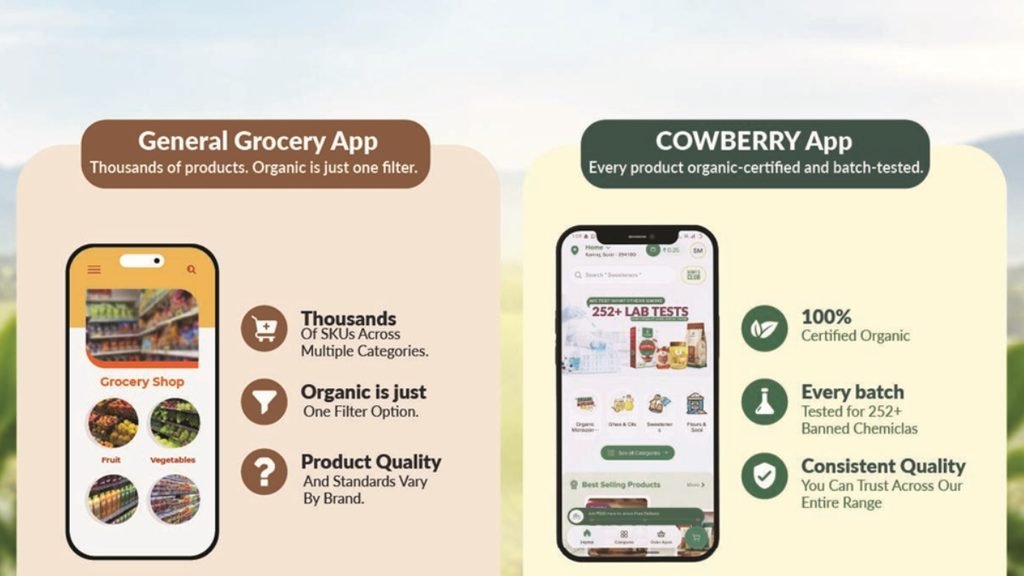
Scale alone doesn’t prove trust — consistent testing across every SKU does.
It’s also worth asking what happens to a claim like ‘largest’ once a customer stops taking it at face value and starts treating it as something to verify, the same way the company asks them to verify a lab report. A grocery app that is genuinely both large and trustworthy should be able to withstand that scrutiny — its testing records, its farmer network, its certification status all standing up to an outside check, not just to its own marketing copy. COWBERRY’s model, built around inviting exactly that kind of scrutiny rather than avoiding it, is itself a bet that the claim can hold up under the same standard it asks its products to meet.
The broader lesson for India’s fast-growing organic delivery category is that scale and trust don’t automatically travel together, and treating them as the same metric is precisely how consumer scepticism about organic claims builds over time. An app can grow its SKU count considerably faster than it can grow a testing infrastructure robust enough to back every one of those SKUs individually. COWBERRY’s bet is that the harder, slower path — keeping testing rigour matched to catalogue size at every stage of growth — is the only version of ‘largest’ worth building toward in a category where the underlying claim has to be checkable, not just advertised.
That trade-off also shapes how quickly a platform like this can realistically expand. Adding a new SKU to a conventional grocery app is largely a sourcing and listing exercise; adding one to COWBERRY’s catalogue means first onboarding a compliant farmer or farmer group, securing certification, and then building the batch-testing pipeline for that specific product category before it ever reaches a customer’s screen. Growth under that constraint will always look slower on paper than growth driven by sourcing alone — but it is also growth that doesn’t have to be walked back later when a scaled-up claim turns out not to hold.
Shoppers who want to see what a tested, verifiable catalogue actually looks like at scale can browse it directly at www.cowberry.com.
If you object to the content of this press release, please notify us at pr.error.rectification@gmail.com. We will respond and rectify the situation within 24 hours.