





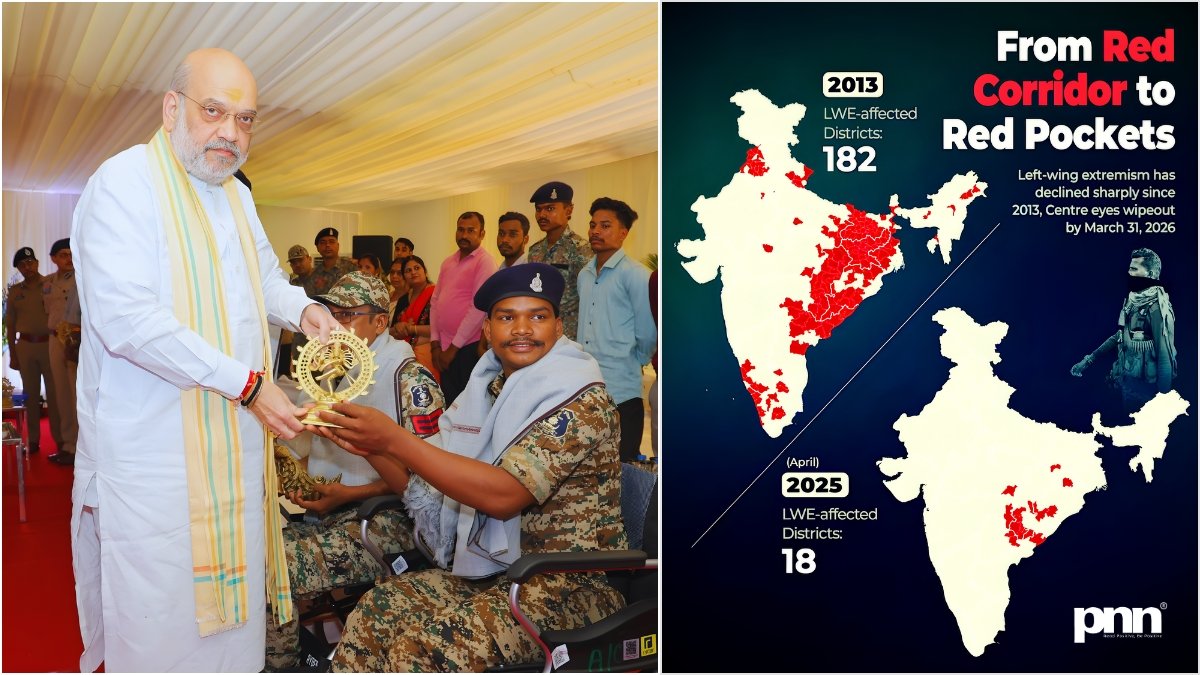
New Delhi [India], October 25: India has turned its longest-running internal war into a masterclass of resolve. A decade ago, Naxalism held sway over forests and fear. Today, the government’s counter-offensive, mixed with development and dignity, is turning red zones into growth zones.
At the same time, the nation celebrates Chhath Mahaparv, a festival that reminds us what faith, patience, and sunlight can build when unity wins over despair.
A Decade that Broke the Back of Naxalism
For years, Naxalism was the stubborn scar on India’s security map. Now, numbers tell a story that even cynics can’t ignore. Between 2014 and 2024, Naxal-related violent incidents dropped by 53%. Deaths of security personnel plunged by 73%, civilian fatalities by 70%. What once was a daily headline has become a footnote.
The Union Government’s integrated strategy for security, development, and rehabilitation has worked like compound interest: consistent, relentless, transformative. Gone are the days of fragmented responses. What replaced them is a high-precision playbook blending boots on the ground, data in the air, and compassion at the heart.
From Firefights to Fortified Foundations
Since 2014, the Centre has pumped muscle into the system: 576 fortified police stations, 336 new security camps, and night-landing helipads across hard terrain. The result? Naxal-affected districts fell from 126 to just 18. Only six remain in the “most affected” category.
Operations like Black Forest and Double Bull are no longer footnotes in police diaries; they’re case studies in how coordination beats chaos. Over 1,225 Naxals have surrendered, and 270 have been neutralised till October 2025.
The tech stack behind this shift is straight out of a modern warfare playbook: AI-backed surveillance, drone imaging, satellite tracking, forensic analytics, and real-time mobile data analysis. Security forces now fight smarter, faster, and with a digital edge once reserved for sci-fi scripts.
Hitting the Naxal Wallet
You can’t wage a war without cutting off the cash. The government understood that early. The National Investigation Agency and Enforcement Directorate have dismantled Naxal funding networks worth nearly ₹100 crore. Urban sympathisers who once drove propaganda now find themselves short on both funds and credibility.
It isn’t just enforcement, it’s financial amputation. The message is clear: ideology doesn’t pay the bills anymore.
Building States that Can Stand on Their Own
Delhi didn’t just centralise the fight; it empowered states to own it. Under the Security Related Expenditure scheme, ₹3,331 crore flowed to Left-Wing Extremism (LWE) states, a 155% jump from the previous decade. Add another ₹991 crore under the Special Infrastructure Scheme for elite state units and fortified stations, and you get why local policing feels more like special ops than beat patrol.
Since 2017, over ₹1,700 crore worth of projects have been cleared, and ₹445 crore disbursed already. It’s a bureaucratic turnaround, less paperwork, more patrol work.
Infrastructure: The Real Weapon
You can’t preach peace to a man who walks 20 km for food. The real counter-insurgency, therefore, was asphalt and fibre optics.
Over 12,000 km of roads built. ₹20,815 crore sanctioned for 17,589 km in total. Thousands of 4G towers, 2,343 in Phase I and another 2,542 sanctioned in Phase II, lighting up dark zones with connectivity.
Banks, post offices, ATMs, and mobile vans now exist where even Google Maps hesitated to go. Nearly 38,000 banking correspondents, 5,899 post offices, and over 1,000 new bank branches now knit together what used to be isolation belts.
Education and skill training followed the same route. ₹495 crore under Kaushal Vikas Yojana funded 48 ITIs and 61 Skill Centres. The Bastariya Battalion, raised in 2018 with 1,143 local recruits, became a symbol of trust where suspicion once ruled.
Reclaiming Red Zones, Restoring Faith
Operations Octopus, Chakrabandha, and Trace, Target, Neutralise have pulled entire regions, Budha Pahar, Parasnath, and Baramsia, back from insurgent control. Even Abujhmaad, once the untouchable fortress of Naxals, has seen security camps established inside.
In 2024 alone, 26 major encounters broke the chain of command: 1 zonal, 5 sub-zonal, and 2 state-level leaders eliminated. That’s not a dent; that’s dismantling the engine.
Rehabilitation remains the final frontier. Ex-cadres receive ₹5 lakh (for top ranks), ₹2.5 lakh (mid-rank), and ₹10,000 monthly stipends for 36 months of vocational training. The result is real reintegration, ex-Naxals building schools instead of bunkers.
A Festival that Reflects a Nation’s Soul
While the forests of Bastar turn quiet, the ghats of Bihar and UP light up. Chhath Mahaparv, the four-day festival of sun worship, has begun, an ode to purity, perseverance, and the Indian way of balancing grit with grace.
Prime Minister Narendra Modi’s message struck a familiar chord: unity, discipline, and devotion. He reminded the nation that Chhath isn’t just a festival; it’s a mirror of India’s cultural DNA, where simplicity outshines spectacle, and faith conquers fatigue.
His post celebrated the global resonance of the tradition, where Indian families from California to Kuala Lumpur gather to offer arghya to the setting and rising sun. It’s ancient spirituality with global bandwidth.
The Prime Minister even shared devotional music, songs of Chhathi Maiya, as a tribute to cultural icons like Sharda Sinha, linking modern India’s digital pulse with its folk heart.
Security and Spirituality: Two Faces of the Same Resolve
There’s a strange poetry in this timing. On one side, a decade-long, data-driven dismantling of Naxalism. On the other hand, a festival where millions stand in rivers at sunrise, praying for renewal.
Both tell the same story: resilience.
India isn’t just winning wars, it’s rediscovering balance. The government’s counter-Naxal success and Chhath’s enduring appeal show the same truth: progress means peace, but peace needs purpose. As India eyes a Naxal-free map by March 2026, the deeper victory is cultural, faith in systems, in sunlight, in something larger than fear.