


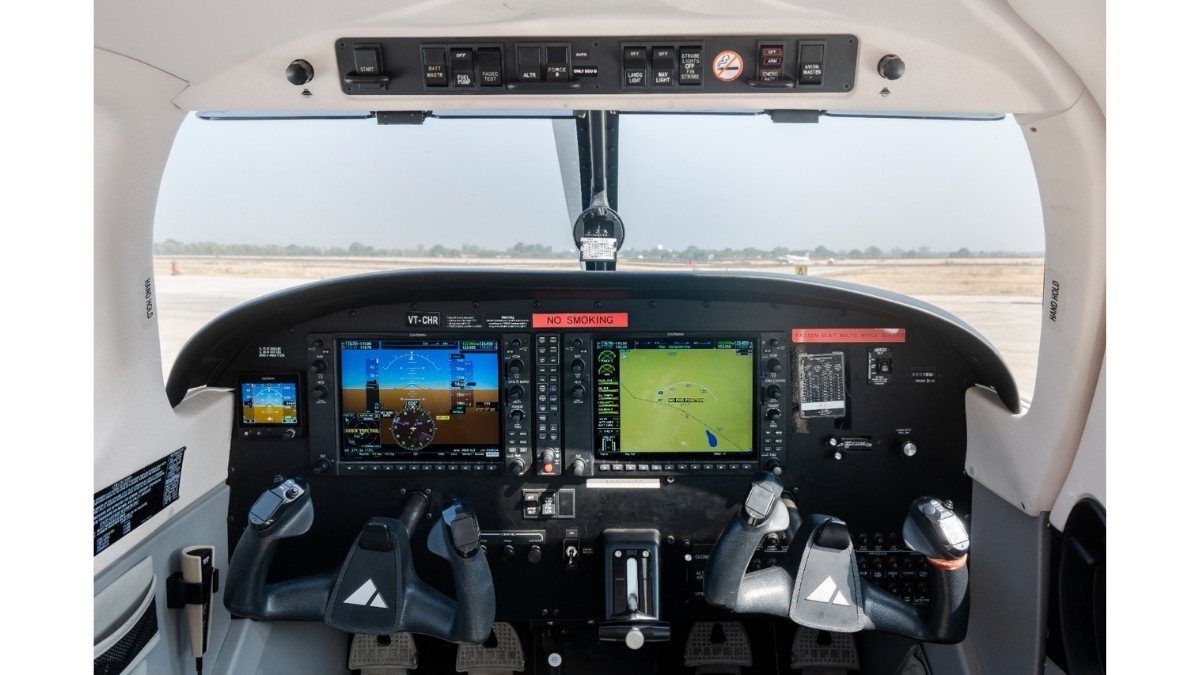
Inside the cockpit of a Piper Archer DX, at Chimes Aviation Academy.
Gurugram (Haryana) [India], June 27: India’s commercial aviation sector is in the midst of a structural transformation. Airlines are placing orders for hundreds of new aircraft, passenger numbers are surging, and regional connectivity under the UDAN scheme is opening up air routes at a pace the country has never seen. But alongside this expansion comes an acute and growing challenge: the country needs more commercially licensed pilots – and it needs them ready for the cockpit of a modern airliner from day one.
That distinction matters more than it may appear. Today’s airline cockpits – across the Airbus A320 family, the Boeing 737 MAX, the ATR 72-600 – are fully digital environments. Primary Flight Displays, Multi-Function Displays, GPS navigation, ADS-B traffic awareness, synthetic vision terrain systems: modern commercial aviation is glass all the way. The question India’s pilot training industry has long faced is why are so many student pilots still completing their licences on analogue aircraft, only to confront an entirely different avionics environment when they reach type rating.
Chimes Aviation Academy (CAA), a DGCA-approved Flying Training Organisation based in Madhya Pradesh, has made a clear institutional choice on this question – and built an entire training infrastructure around it.
A fleet designed around the commercial cockpit
Established in 2007 and operationalised in 2008, CAA has spent nearly two decades constructing what it describes as one of India’s most modern and largest training fleets. With 33 modern aircraft operating across airfields in Madhya Pradesh, the fleet reflects a deliberate training philosophy: every aircraft, from the ab initio Cessna 172 R/S to the multi-engine Diamond DA42, is fully equipped with the Garmin G1000 NXi Glass Cockpit.
The fleet comprises 30 single-engine aircraft across three types — the Cessna 172 R/S, Piper Archer DX, and Tecnam P2010 Tdi — and 3 Diamond DA42 twin-engine aircraft used for Multi-Engine Instrument Rating (MEIR) training. What is significant here is not simply the number of aircraft, but the consistency of philosophy across the entire fleet.
Every aircraft, from the primary trainers to the multi-engine capstone, shares the same Garmin G1000 NXi glass cockpit suite, ADS-B capability, and FADEC engines. A student at CAA encounters glass cockpit avionics on day one of flying training and continues to build on that foundation through every stage, up to and including multi-engine operations.
Why glass cockpit training from day one
The case for glass cockpit-first training has strengthened considerably as the industry has matured. The airlines that employ the graduates of flying training organisations operate an exclusively glass cockpit fleet. The transition from an analogue training environment to an airliner’s Primary Flight Display has historically required additional adaptation time – a cost borne both by the cadet and, to varying degrees, by airline training departments.
CAA’s position is that this transition cost is avoidable. As the academy puts it, the Garmin NXi glass cockpit integration “ensures that cadets cultivate an acute sense of situational awareness and proficiency in navigation, helping them transition easily to operating the sophisticated avionics predominant in modern commercial aircraft.”
The benefits are cumulative. A cadet who has spent 200 flying hours interpreting a PFD, managing GPS navigation, reading synthetic vision terrain, and operating ADS-B traffic awareness systems arrives at type rating training with a mental model that is directly applicable to the airline cockpit. The learning curve at that stage narrows considerably – and in an industry where type rating represents a significant financial and time commitment, that narrowing carries real value for both the cadets and the airlines they join.
The training ecosystem: from ground school to commercial licence
The fleet strategy sits within a larger training infrastructure that CAA has built across Madhya Pradesh, supported by its Ground Training School and corporate office in Gurugram, Haryana.
Ground Training School, Gurugram: The entry point for every CAA cadet. Located in Gurugram and co-located with the academy’s corporate office, the GTS provides cadets with DGCA theoretical examination preparation and houses an ADAPT Test Centre. DGCA examination pass rates are one of the key indicators used by the academy to measure ground school performance.
Dhana Airfield, Madhya Pradesh: CAA’s founding flying base, operational for over 18 years. It provides secure on-campus accommodation for 100+ cadets, dining facilities, and a CAR-145-certified maintenance facility – meaning all aircraft maintenance is conducted in-house, under the same roof where training operations run.
Neemuch Airfield, Madhya Pradesh: A more recent addition and fully operational training base, Neemuch houses 150+ cadets and features its own CAR-145 maintenance centre. The base plays an important role in CAA’s flight training operations and supports its growing fleet of modern training aircraft which are located across both bases.
The geographic design of the airfields network carries a training logic of its own. The two active airfields are approximately a cross-country flight apart – a fact that CAA highlights as an embedded training advantage, given that cross-country navigation is a mandatory component of CPL licence requirements. Madhya Pradesh’s year-round flying weather further ensures that training hours are not eroded by seasonal disruptions, a meaningful differentiator for cadets whose program timelines are tied to flying hour milestones.
The IndiGo association: a structured pathway to the airline cockpit
The most consequential expression of CAA’s pilot-readiness philosophy is its formal association with IndiGo, India’s largest airline by market share. Since 2019, CAA has operated the CAA-IndiGo Cadet Pilot Program (CPP), which CAA describes as India’s only entirely homegrown, full-time cadet pilot program for IndiGo.
The program runs end-to-end: cadets begin with DGCA ground school in Gurugram, proceed to flying training at the Madhya Pradesh airfields, and complete the journey with an Airbus A320 Type Rating before joining IndiGo as Junior First Officers. Total program duration is approximately 20 months.
By May 2026, CAA had conducted the Letter of Intent signing ceremony for IndiGo Cadet Program Batch 12, marking over six years of continuous cadet program delivery. The sustained, multi-batch operation of an airline-linked cadet pipeline is a distinction that only one flying training organisation in India can claim, and it reflects the degree to which CAA’s training standards have been calibrated to airline requirements rather than to a generic CPL threshold.
The numbers behind 18 years of operations
Since its founding, CAA has accumulated a set of operational milestones that speak to both scale and consistency:
- 200,000+ total flying hours logged since inception
- 1,000+ alumni now employed across the aviation sector
- 33 aircraft in the current active fleet
- 11 months – average CPL training duration
- Among the lowest incident rates in the Indian FTO sector over 18+ years of operations
- Associated with IndiGo for their Cadet Pilot Program since 2019
The broader context: India’s pilot Supply imperative
India’s commercial aviation sector places significant demands on the training pipeline. Industry projections anticipate continued fleet expansion across domestic carriers, with new aircraft deliveries planned well into the next decade. Alongside airport infrastructure investment and regional route expansion, the demand for commercially licensed pilots is expected to outpace the current rate of CPL graduates if training capacity does not scale proportionately.
CAA is also an active advocate of the government’s “Atmanirbhar Bharat (Self-Reliant India)’ initiative – the principle that aspiring Indian pilots should not need to travel abroad to access world-class commercial pilot training. With DGCA-approved flying programs, airline-linked cadet pathways, a CAR-145 certified maintenance operation, and a glass cockpit fleet, CAA positions itself as evidence that internationally competitive pilot training is achievable entirely within India.
Alumni: the measure of the model
The ultimate measure of a flying training organisation is reflected in the career professions of their graduates. CAA’s alumni network – known collectively as Chimes Aviators – now includes pilots flying for IndiGo, Air India, Air India Express, Akasa Air, Emirates, Qatar Airways, AirAsia, and others. Several have progressed to Captain rank.
This growing alumni community of over 1,000 represents the compounding return on a training philosophy that has remained consistent across 18 years and through multiple shifts in India’s aviation sector.
Final thoughts
As India’s aviation sector continues its expansion, the quality and readiness of the pilots entering its cockpits will be one of the defining variables of that growth. Chimes Aviation Academy’s model offers a considered answer to the question of what pilot readiness, properly defined, should look like.
For further information on Chimes Aviation Academy’s programs and facilities, visit caaindia.com
If you object to the content of this press release, please notify us at pr.error.rectification@gmail.com. We will respond and rectify the situation within 24 hours.