

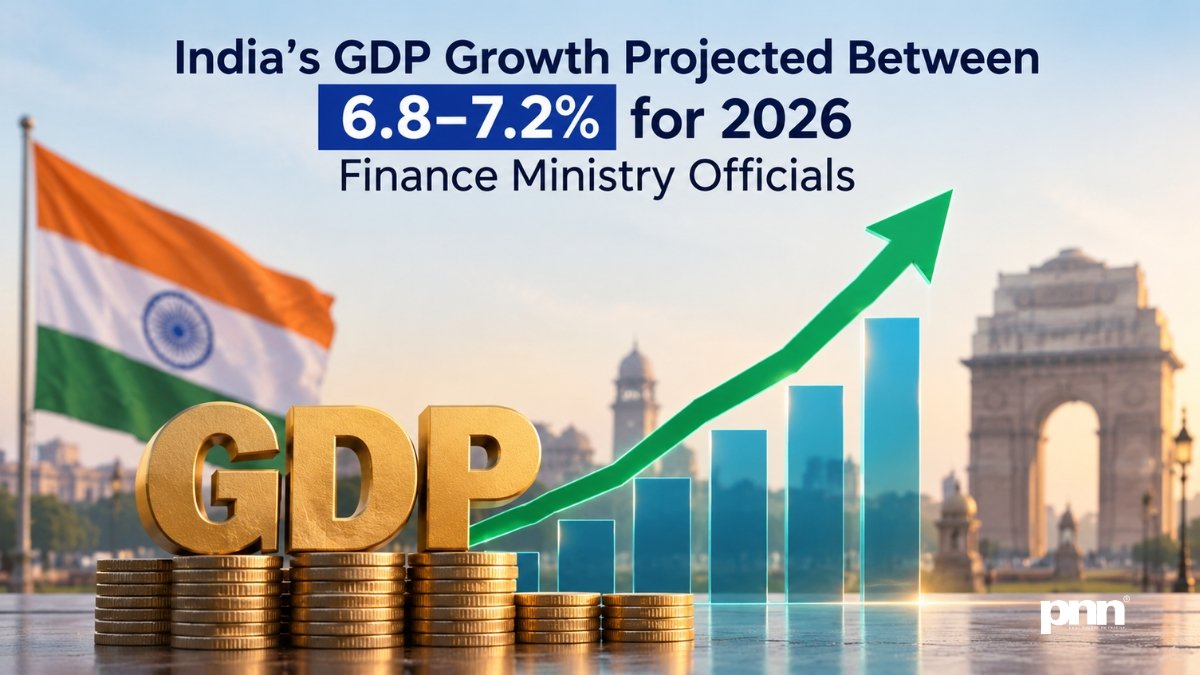
Mumbai (Maharashtra) [India], July 28: When the Economic Survey hit Parliament this year, it tossed out a number that quietly put a lot of nerves at ease: 6.8 to 7.2 percent. That’s where the Finance Ministry expects India’s growth to land for FY27, which kicks off next April. Not exactly earth-shattering, but it says a lot about the country’s ambitions—India, still the world’s fastest-growing big economy, wants to stick to a steady pace, even as the global outlook gets more unpredictable by the day.
Why does this number matter? Well, look at what came before it. The fiscal year that’s wrapping up—FY26—should end with real growth somewhere between 7.4 and 7.6 percent, according to the Ministry of Statistics and Programme Implementation. That’s better than anyone in the government dared hope for when they put the Budget together. Back then, worries about American tariffs and less access to discounted Russian oil led them to peg growth closer to 6.3-6.8 percent. Instead, the economy pushed through. Private consumption rose 7.7 percent—up from 5.8 percent the year before—and capital formation held steady at about 7 percent.
Why the Number Looks Lower Than It Sounds
Now, the projected dip from 7.6 percent to the 6.8-7.2 percent range isn’t a red flag. Chief Economic Advisor V. Anantha Nageswaran and his team have said for a while that India’s “potential growth” rate hovers around 7 percent. That’s the speed India can keep up without overheating—like how a marathon runner finds their best pace. Last year’s boost had some one-off wind at its back, so this next number isn’t a slowdown; it’s more like settling into a sustainable groove.
This has happened before. In the FY25 Economic Survey, the government forecasted 6.3-6.8 percent growth for FY26—then rural demand and services exports ended up outpacing their guesses, and actual growth broke through the ceiling. That’s why these projections land in a range. It leaves room for the world to surprise you—sometimes for better, sometimes for worse.
What’s Actually Driving the Engine
What’s driving all this? It still comes down to consumption. Household spending now makes up 61.5 percent of GDP—a level we haven’t seen in a long time. Take a walk through any mall in a city like Indore or Coimbatore and you’ll see it firsthand: folks eating out, upgrading their phones, shopping during the festivals. It’s not just Mumbai and Delhi anymore; the consumer boom has spread further than ever.
Services exports are pulling weight, too—they grew 6.5 percent from April to December 2025, while merchandise exports crawled up just 2.4 percent, pressured by US tariffs. IT services and global capability centers—think the big back-office hubs for companies like JPMorgan, Goldman Sachs, and half of Europe’s banks, all parked in Bengaluru, Hyderabad, and Pune—have stayed strong even as trade fights take chunks out of other sectors.
Remittances don’t get enough attention, but they matter. The money sent back by the 18 million Indians working abroad—from laborers in the Gulf to techies in Silicon Valley—has consistently outpaced foreign direct investment in recent years. That, plus a healthy services trade surplus, kept the current account deficit at just 0.8 percent of GDP.
The Fiscal Tightrope
On the government’s side, this growth hasn’t come without tight budgeting. In her February Budget speech, Finance Minister Nirmala Sitharaman said the fiscal deficit was cut to 4.4 percent of GDP for FY26, with plans to bring it down further to 4.3 percent next year. To bridge the gap, the government’s aiming for Rs 11.7 lakh crore in net market borrowing via dated securities; gross borrowing is expected to touch Rs 17.2 lakh crore.
But they’re not pulling back on capital spending. The plan is to put Rs 17.15 lakh crore toward infrastructure in FY27—roads, railways, ports—the stuff that keeps goods moving and factories humming. It’s a balancing act: reduce the deficit, but keep the investment pipeline healthy enough for businesses to keep planning long term.
A Cushion Against Global Shocks
Another safety net? As of mid-January 2026, India’s forex reserves could cover more than 11 months of imports and about 94 percent of outstanding external debt. That kind of cushion means the Reserve Bank can manage the rupee without breaking a sweat, even when things get wild—oil prices spike or the dollar surges.
The Road Ahead to Viksit Bharat
Looking down the road, the government keeps bringing up “Viksit Bharat 2047″—a vision for India as a developed economy by the hundredth year of independence. The Economic Survey says getting there will rely less on sweeping new reforms (the big ones, like GST and the insolvency code, are already in place) and more on bringing in better tax compliance to slowly boost the tax-to-GDP ratio.
So, the 6.8-7.2 percent forecast is less about bragging rights and more about setting expectations. For families, it’s a clue about jobs and paychecks. For companies, it’s a sign about whether to hire or expand. For global investors, it’s a message: India’s planning to keep outpacing most big economies, no matter what the world throws its way.